Tuesday, February 13, 2018

India - Feb 2018 - 6th Post - Wednesday in Jhodpur

First, a little Hindi lesson. You will notice that many of the cities we have visited end with three letters, “pur”. Udaipur, Jhodpur, Jaipur etc. In Hindi, “pur” means “city”. 

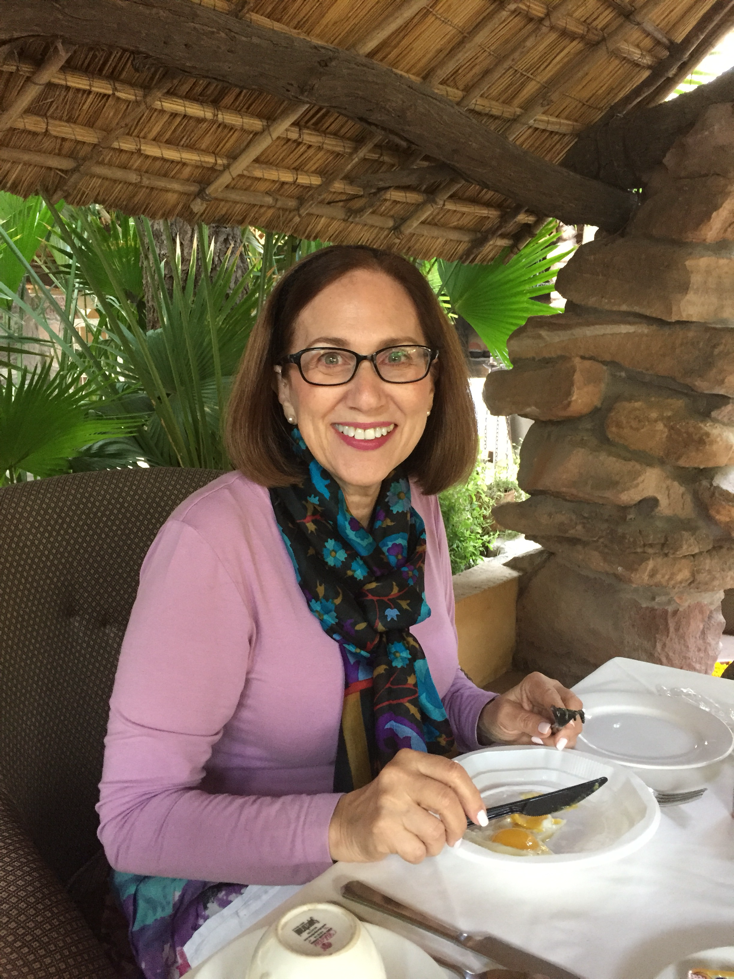
We began Wednesday with breakfast at our hotel, the Ajit Bhawan. India Kosher Travel had provided us with a fry pan, spatula, and a bottle of oil and had sent messages to the chefs in each of our hotels regarding the manner in which to prepare our meals. As well, they had wisely suggested to the chefs that they provide us with a relatively private area for us to “eat and pray”.

And so when we arrived for breakfast, once again the hotel had set up a very private area for us on a covered patio area. We accompanied the chef to the gas range and they prepared wonderful eggs for us to get us going for the day.

Our destination this morning was the massive Mehrangarh Fort, built in 1459 and perched high on a 150 metre hill. We think of a “fort”as something from the cowboy movies of the Wild West but here in India a Fort is what we would consider a castle or a palace. 

As we made our way up the hill toward the Fort, we stopped at Jaswant Thada, which is the cremation ground for the Royal Family of Marwar who ruled Jhodpur. There is a beautiful mausoleum or cenotaph on the grounds, built out of intricately carved sheets of highly polished marble. 
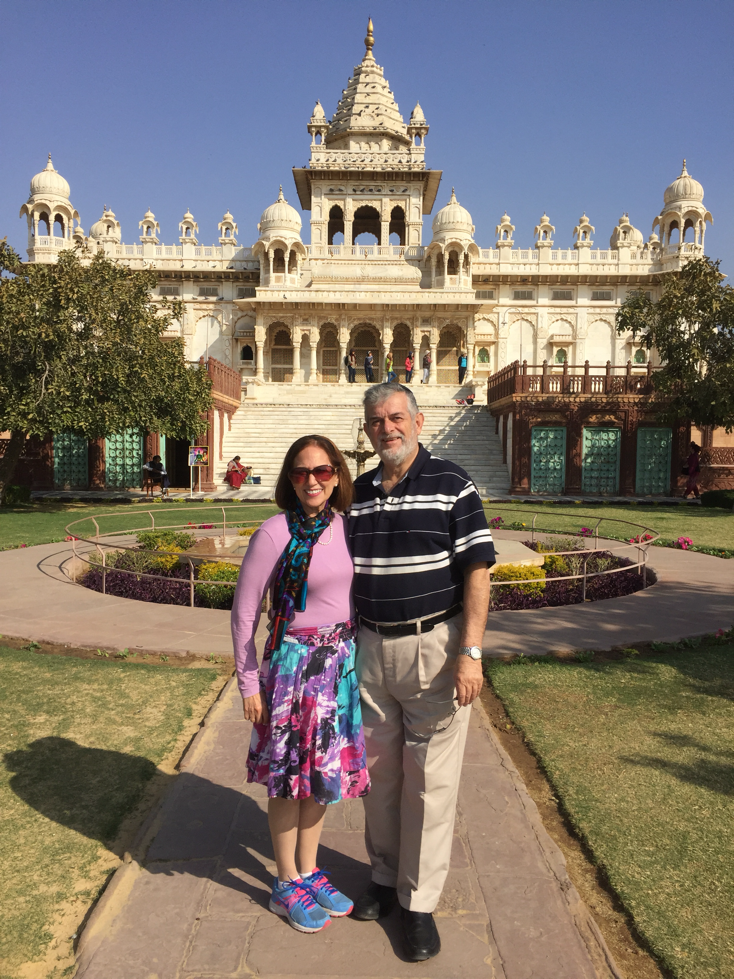


Our guide for the day, explained the entire cremation process and its place in the Hindu tradition. It was quite interesting. Here is the view of the fort from the mausoleum grounds.


Seated outside the Mausoleum was a traditionally dressed tribesman, who was playing a sitar like instrument called a ravanhastha. It is made of a bamboo shaft, with half a coconut shell covered with goat skin at the base and 17 metal strings and is played with a bow that has oxtail hairs. It had a beautiful sound and I even tried to teach him to play “hava nagila”.

We continued to the Mehrangarh Fort and spent a couple of hours touring this amazing place. The building of the Fort began in 1459. by Rav Jodha, founder of Jodhpur but most of the construction dates to the Marwar king Jaswant Singh who ruled from 1638 to 1678. They have recently added an elevator to the Fort so that we would not have to climb to the main halls high atop the hill. There are seven gates to the fort and one of these is named Victory Gate, built by Maharajah Ajit Singh in 1806 to mark the defeat of the Mughals. 


Within the fort grounds are several beautiful palaces including the Flower Palace and the Mirror Palace, which house priceless collections of royal cradles, miniatures, costumes and elephant carriages. From the top of the fort, we had an excellent view of the city of Jodhpur, known as the “Blue City”, called by this name for a number of reasons. First, the city had a large number of Brahmins, the priestly class at the top of the caste hierarchy, and so their homes were painted to set them apart from the lower castes. Second, it was thought that the indigo dye kept termites away. And third, it was believed that the blue colour kept homes cooler in the harsh summer heat.


When we left the fort, we made our way to the centre of town and the market area that surrounds the clock tower. Again we passed by many booths making deep fried sweets, spices, milk being transported in old fashioned milk jugs and we enjoyed the hustle bustle and splash of bright colours everywhere.

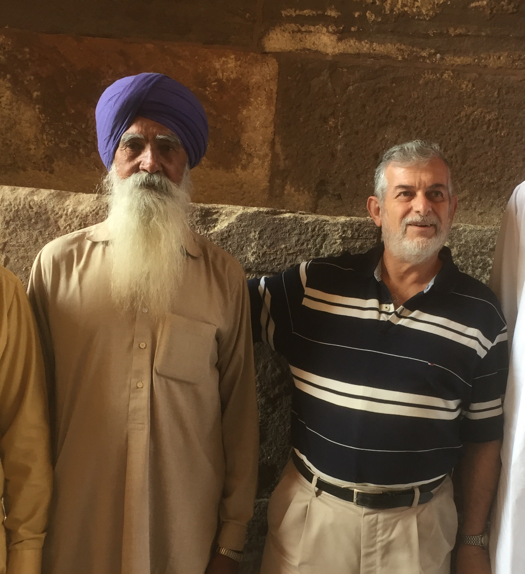

We spend a couple of afternoon hours relaxing by the hotel pool and and then went on a Jeep safari to the Bishnoi Villages nearby where we were introduced to local tribesmen and local crafts.


First we visited the local potter and Fran worked with him on the wheel making clay pots. His main product was round water jugs which people would carry on their heads to transport potable water to their home. The potter had been doing this for years as had his father and grandfather before him. 


He was a very personable and happy person, spoke English well, and introduced us to his daughter in law and grandchildren, who all lived together in the family compound. His daughter in law had her face covered even though she was in her home, because as Muslims, only the daughter would uncover in her own home. 


We now travelled to a local Bishnoi farmer who demonstrated the art of turban tying and the tradition of opium water tasting. The turban material unravelled measured 9 x 2 metres and he effortlessly, in a matter of seconds created a beautiful turban for himself. He then dressed Fran in a Sari and we took a photo as the typical Rajasthan couple. 


The opium ceremony is part of their religion and even though opium is illegal in India, possession by the Bishnoi is overlooked because it is part of their religious rites. 

The farmer took us out to see his water buffaloes and we noticed piles of cow dung patties stacked up around his field. The local women collect the cow dung, flatten them into patties which are used as fuel for heat and cooking, and they are also apparently effective at keeping insects out of your home. When it is mixed with clay, it can be used for flooring which we would see on Thursday when we arrived at our next overnight location. 


It looked like this was a very primitive and basic lifestyle, until we noticed his smart phone and his nearby motorcycle. 

Our third stop in the village was the home of the weaver. He had a loom and was weaving tightly knit cotton rugs which would last for a long time. The art had been in the family for centuries. When we met the weaver, we did not expect that he would converse with us in English but when he opened his mouth, out came an almost accent free pronunciation of the English language. When I asked him where his English was from, he said with a very straight face, “I spent a number of years at MIT in Boston, where I studied engineering. However, I preferred the basic lifestyle do I moved back here to pursue may career as a weaver”. After I said “wow”, he started laughing and said “I have never gone to school; I was pulling your leg and have learned all my English from tourists like you”.


He gave us a quick lesson on weaving and showed us some finished products and then ended with “we accept all major credit cards and ship by courier anywhere in the world”. It seemed so incongruous given the primitive village where we were standing, but I guess, as seasoned travelers, we should be used to this by now.

We returned to the hotel, and had our dinner; this time inside the restaurant, no chuppah for us tonight. The meal was again delicious....so far Chabad Delhi and India Kosher Travel have delivered.

Tomorrow, Thursday, we travel to near the village of Nimaj, to the tent resort of Chhatra Sagar. We were told that this will be an incredible experience. We will see.

All the best

Fran and David


Monday, February 12, 2018

India February 2018 - 5th Post - Tuesday from Udaipur to Jhodpur

On Tuesday morning, we checked out of the Udai Kothi Boutique Hotel and were picked up by our driver Vikram.

A few words about our travel provider. India Kosher Travel is owned by Mosher Goldstein, the brother of the Chabad Shaliach in Pushkar, Rabbi Shimmy Goldstein. He has been our main contact thru the entire planning process and has been very clear and responsive to requests and inquiries. The local tour company that he works with in India is an outfit called Carmel Tours. They are the contact people for local needs and requests. They provide the cars, the travel bookings and the drivers and guides. Carmel is owned by local Indian people but works very closely with a number of Israeli tour agents (like Moshe) and has wisely, imho, chosen the name Carmel. 

As such all their guides and drivers are very familiar with kashrut needs, with Shabbat restrictions and with the interests and needs of the Jewish/Israeli/kosher traveler. 

In each location there is a different local Carmel guide who shows us the sights of the city or region. You are with that guide for a day or two and then the next regional person takes over. 

One of the things that have been enjoying so far, is that our driver, Vikram, has been assigned exclusively to us for most of our trip to India. Vikram, is a very pleasant man, an excellent driver and companion, with a very good sense of humour.  He picked us up at the airport, was there on our arrival in Udaipur and will be with us till the beginning of our last week here, at which time we will be flying to a number of different areas of the country. 

As well, Vikram has toured with many Israeli tourists and has picked up some of the Hebrew lingo that many of us would be used to hearing on the streets of Jerusalem and Tel Aviv. 

On Tuesday, we would be spending most of the day with Vikram, as we had a 6 hour drive between Udaipur and Jodhpur. When I first saw this on the itinerary, it was kind of unnerving, as this is a long time to spend in a car, even given that the SUV that we had been assigned is very comfortable and spacious. 

As well, if you look at Google Maps, you will notice that the distance between Udaipur and Jodhpur is only 259 kms. and yet Google Maps tells you that the time to drive this route will be over 4 and a half hours. So right away, you know that the roads are not going to be too great. Additionally, even though stretches of this route are via a four lane divided highway, Vikram explained to us that most highway speed limits are 80 kms. per hour and that car manufacturers have placed “limiters” on commercial or tourist vehicles that will not allow the car to exceed the 80 km per hour maximum even if the driver presses the accelerator to the floor. Add to that, the cows that meander everywhere and the weaving in and out by motorcycles, cars and huge trucks and one can begin to see that you cannot cover any distance in India as you would in North America, Europe or Israel. This is a world that we have never experienced before.  


But Vikram said to us as we left on Tuesday “You will have a very interesting day today as I am going to show you MY INDIA”. Along the way between Udaipur and Jodhpur, the long trip was broken up by a number of very interesting stops. Indeed, it was a fascinating day!

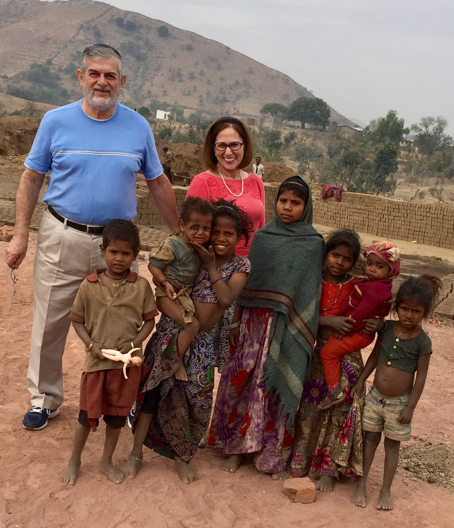
Soon after we left the city limits of Udaipur, Vikram pulled off the highway near what looked like a huge smoking oven on the side of the road. Vikram explained that this was a brick manufacturing facility where all the work is done by hand. We met the brick maker who works for the company that owns the location and who lives together with his wife and a bunch of children in what could only be described as a six foot by ten foot brick enclosure. The wife was cooking on an outdoor fire, the kids were running barefoot among the bricks and the husband was making bricks..... one at a time. He used a metal mould for the bricks, filled it with a clay mixture and placed the bricks in a neat row to dry in the sun. Once the bricks had dried sufficiently, they were placed in the kiln for hardening, stacked into large piles and sold by the company to builders or building supply companies. The brickmaker will earn $2 to $3 a day depending on how many bricks he completes.


What was remarkable was how friendly the kids were. They all gathered around us and while we were warned on numerous occasions not to give them any money, we asked Vikram if we could give them some of the chocolate bars that we had with us. The kids were so appreciative. It looks like a very poor and difficult existence, but like so many other places we had been to in India, the people looked happy and were very friendly and welcoming.

The only source of drinking water that these people had was a rationed amount supplied per day by the government and delivered by pipes. And since there was no well or spring nearby, it was clear that no water was being wasted on things like bathing. 

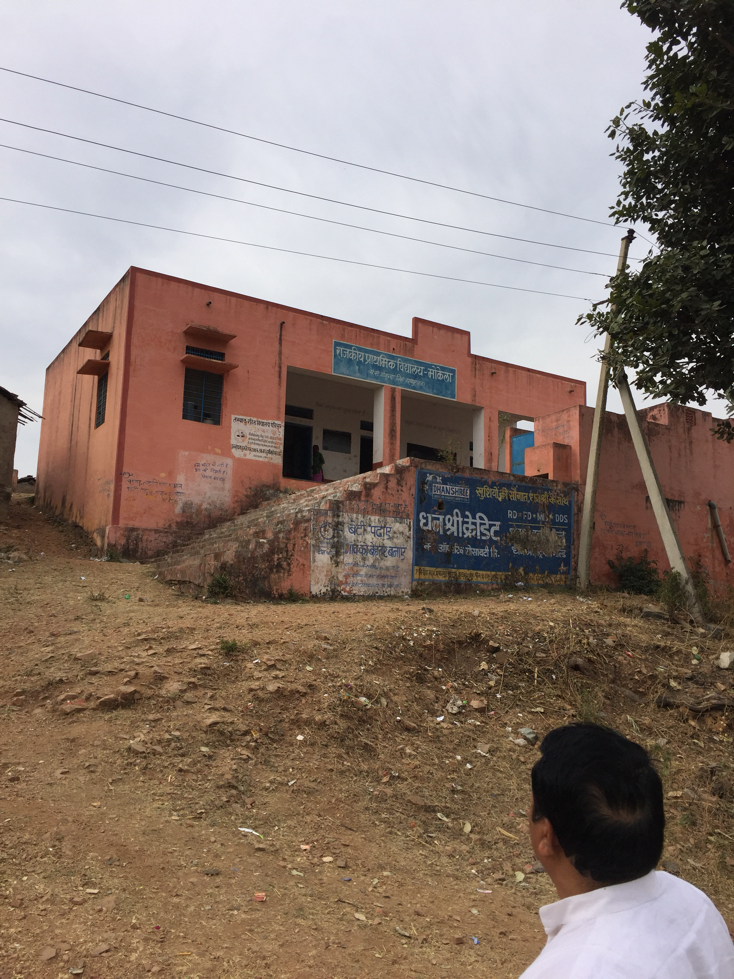
We drove a short distance further and then pulled off the road and Vikram said, “let’s go see a school”. 

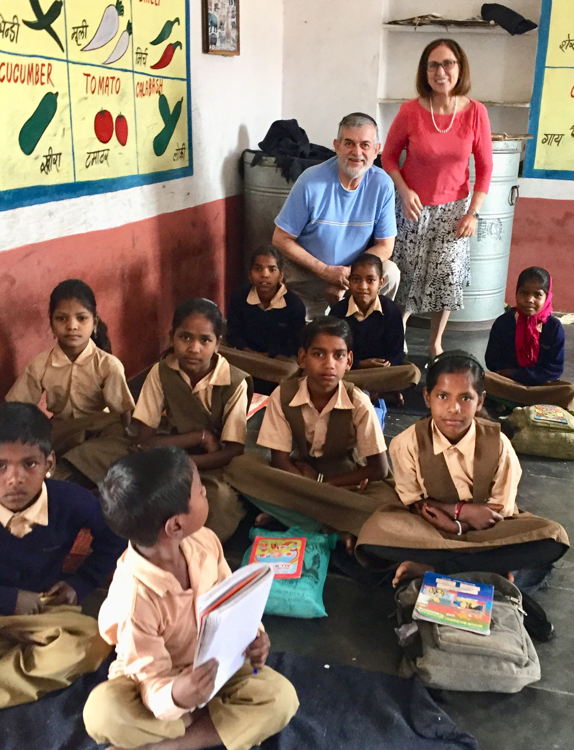
It was a two or three room schoolhouse with an office, a kitchen and an outdoor toilet facility. We entered one of the classes and they were in the middle of their English class. It was grades 2 to 6 combined, so you had kids who looked to be 6 or 7 and kids who looked to be 10 or 11. When we walked in all the kids rose out of respect and they were all wearing government mandated uniforms although many were barefoot. We chatted with them for a while and then took a group picture. They were clearly happy to meet us. After seeing the facilities or lack of them, we should be so appreciative of what we have in our homes, communities and schools.


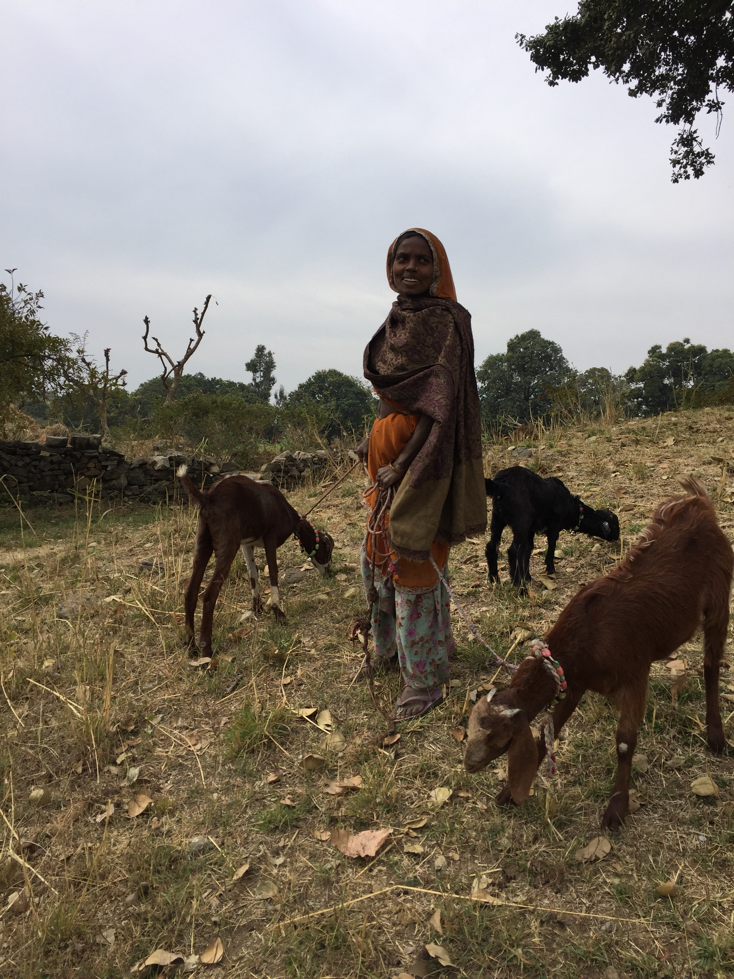
We continued on our way and drove past shepherds herding goats, women working at cleaning up the sides of the roads (a government initiative that pays them a few dollars a day), and soon arrived at what Vikram described as a water wheel. 


India is in desperate need of water and rain. We had been told a number of times in the few days since we arrived that the last time it rained was in September, 4 to 5 months ago. It is not expected that there will be any rain until June, when the monsoons arrive. 

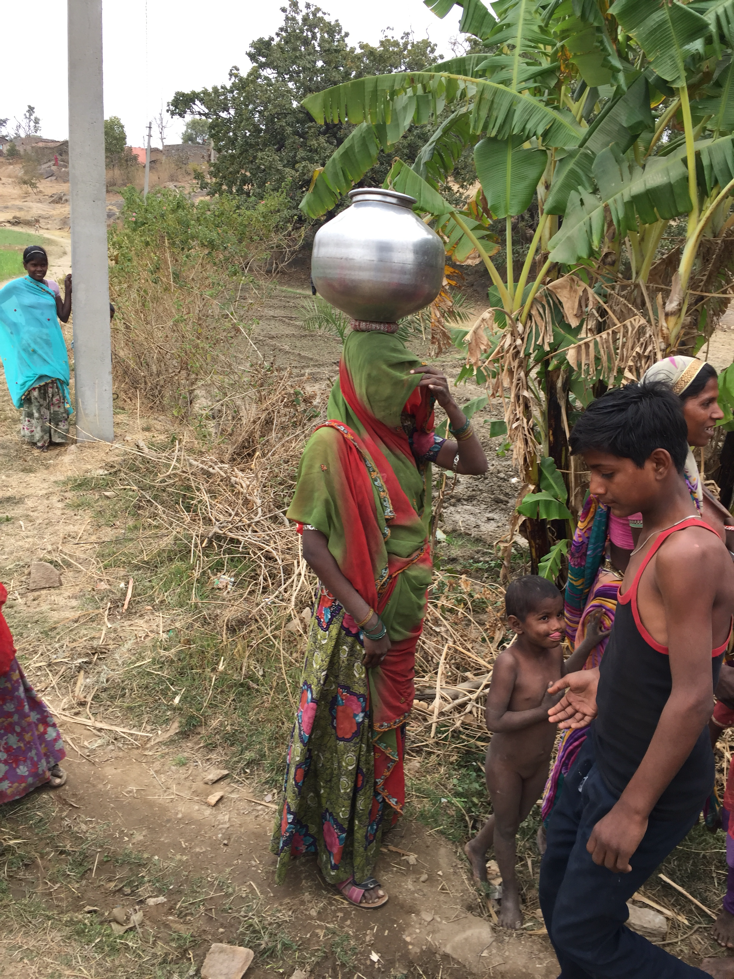
The farms in the area are mainly irrigated by water extracted from wells that dot the area. There are deep wells with a water wheel operating over the mouth of the well. The water wheel drops many buckets into the well and the double ox driven wheel brings the buckets with water to the top where the water falls into a trough and it is diverted from there to irrigate the surrounding farm land. As well, women from the area come to the well with their metal water jugs, fill them up and carry them back on their heads to the village so that they have fresh drinking water.


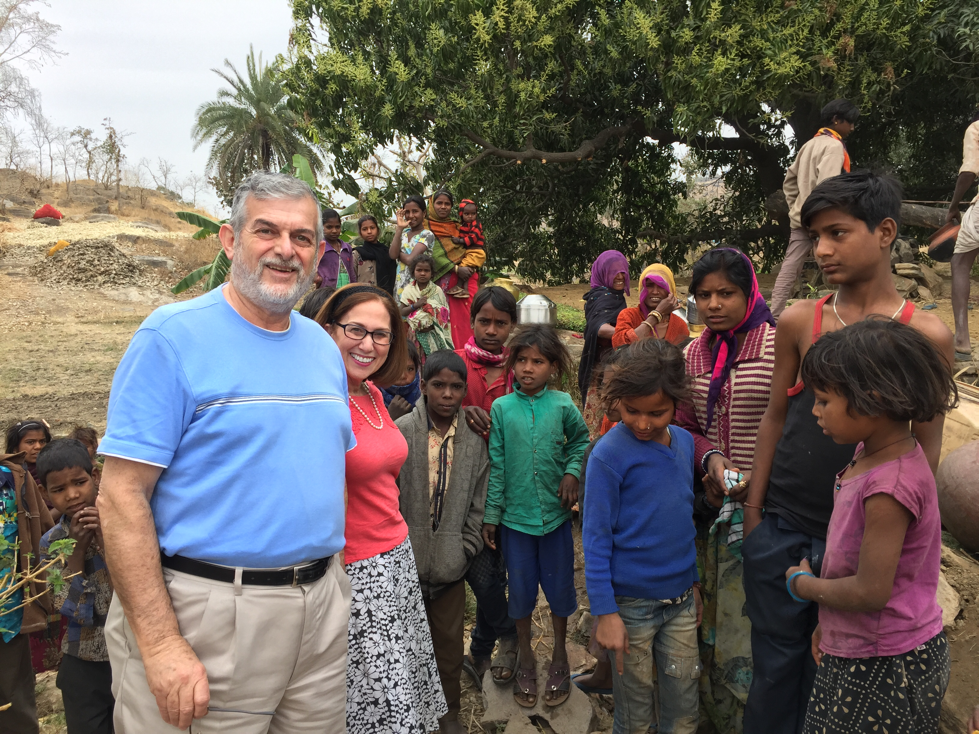
We got out of the car and as soon as we began walking towards the well, kids began running to us from all directions. They gathered around looking at us and were eager to say “hello Ma’am” and “hello sir”. And they wanted to pose with us for a picture. Again, very welcoming and friendly.


We drove on and came to a small village shopping area. We walked around the various stalls and stores and at one location, we were approached by a man who looked at my kippah and said “are you a Muslim”?

I responded that I was Jewish and from Israel and he said “oh Israel....great and mighty nation. And Netanyahu is a good friend of India and Modi”.

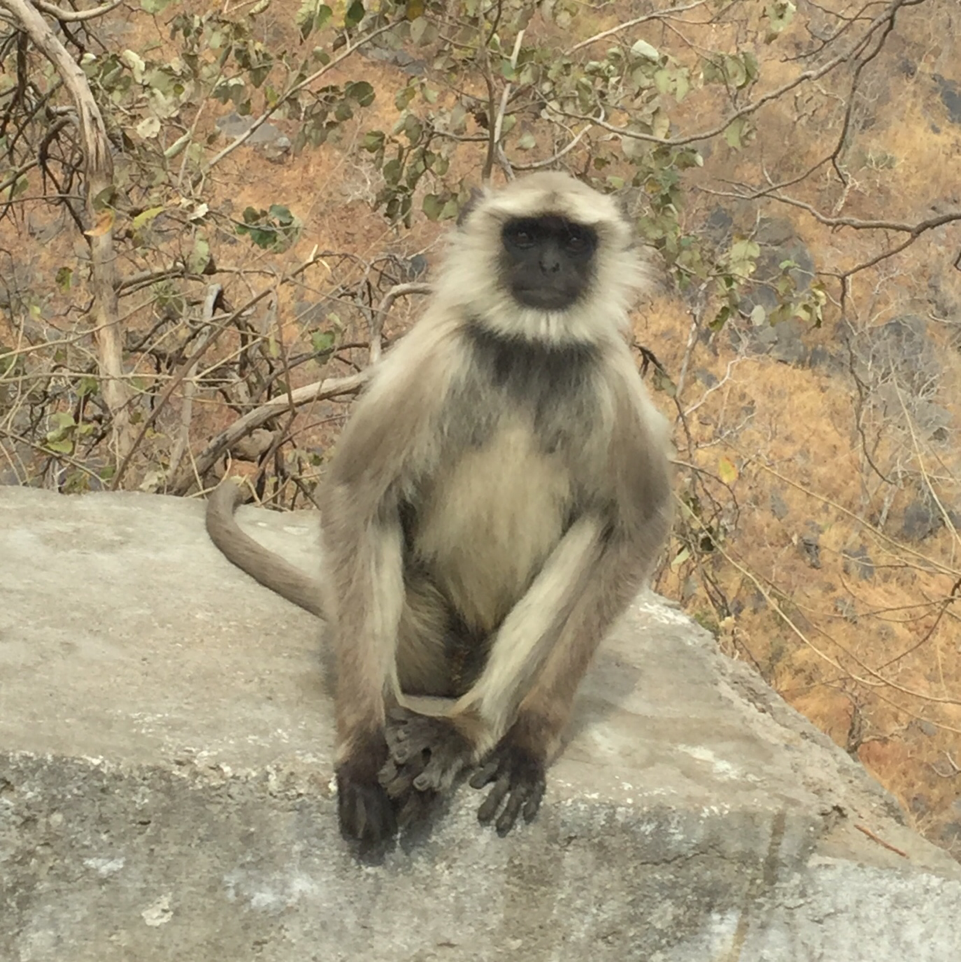
We then drove through an area on the highway where there were hundreds of monkeys roaming free on both sides of the road. When we pulled over, they jumped on the car and we had the opportunity to take some pictures. 


We stopped to see the outside of a Jain Temple. The Jain Religion is an ancient offshoot of Hinduism that preaches non violence, non confrontation, vegetarianism and other noble principles. There are only about 4 million followers of Jainism in the world with three million of them being in India. 

We continued to Jodhpur and arrived at our hotel, the first heritage hotel in India, the Ajit Bhawan Palace. 

Built in 1923 exclusively for Maharaja Sir Ajit Singhji Rathore of the Jodhpur State, The Palace Resort, was designed by an English architect and was executed in Jodhpur stone. While part of the palace was converted into a luxury hotel, the remaining portion is still inhabited by the Jodhpur Royal Family. 

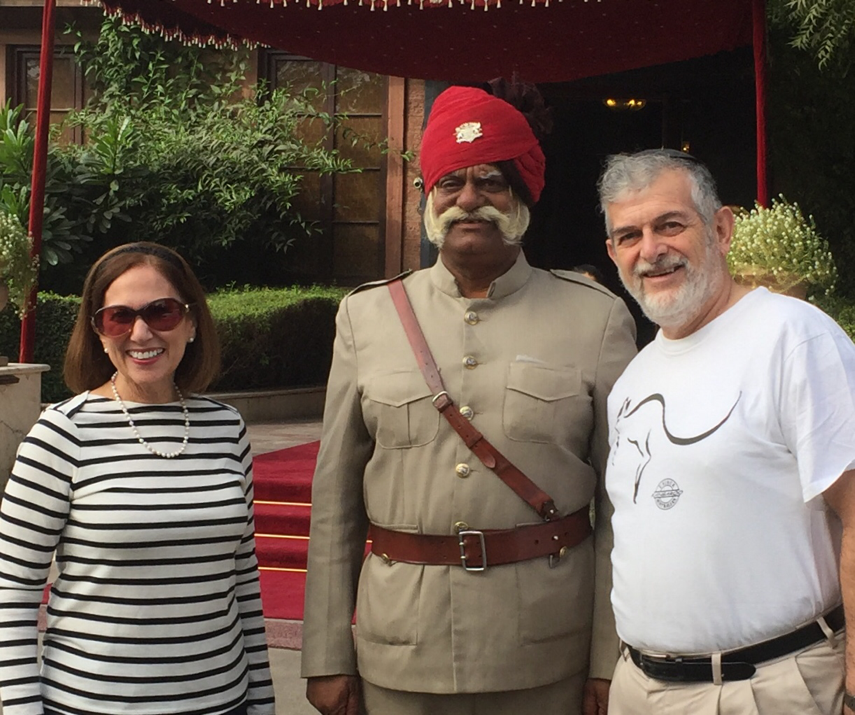
Upon arrival, you get the feeling that you are entering an authentic Maharaja’s palace. Greeted by a turbaned and mustachioed doorman, you are ushered into a panelled study lined with photos of all members of the royal family of Jodhpur, where one attendant brings you a hot towel and another offers you a glass of iced tea. This is no typical hotel front desk check in. 


We were taken to our suite, which was actually a unique bungalow like accommodation with its own front yard. It was opposite the outdoor and indoor dining area and further back was the dramatically designed swimming pool and the very well equipped gym. 

The concierge informed us that our meals had arrived from Chabad Delhi and asked us when we would be ready to eat dinner. They showed us the instruction sheet that had accompanied our meal and informed us that they had set up a unique and unforgettable location for our kosher dinner.

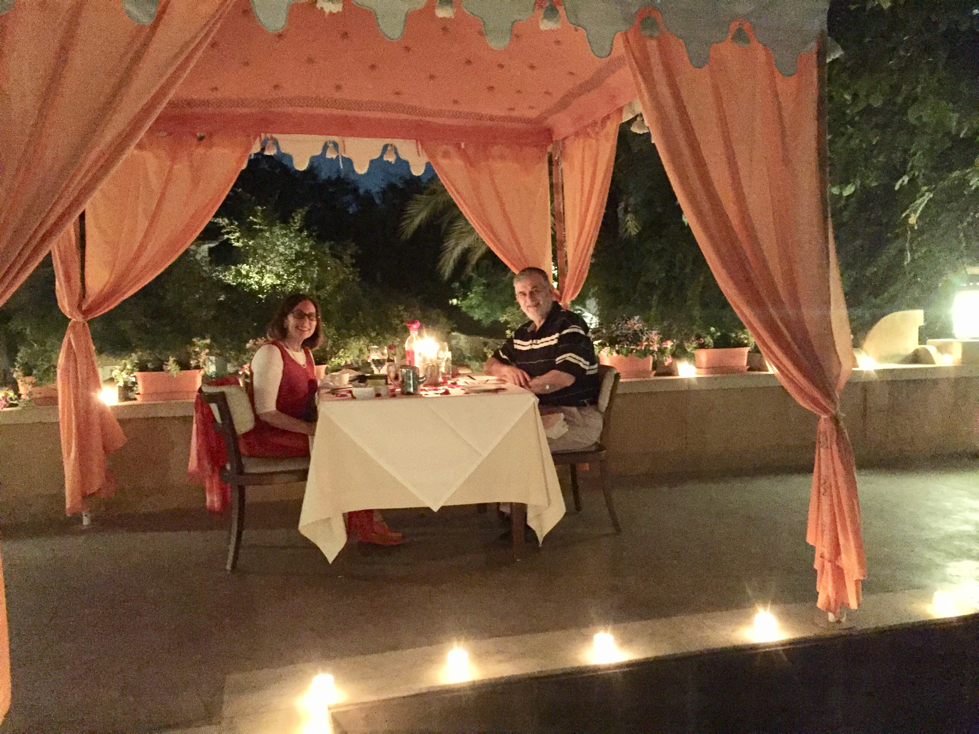
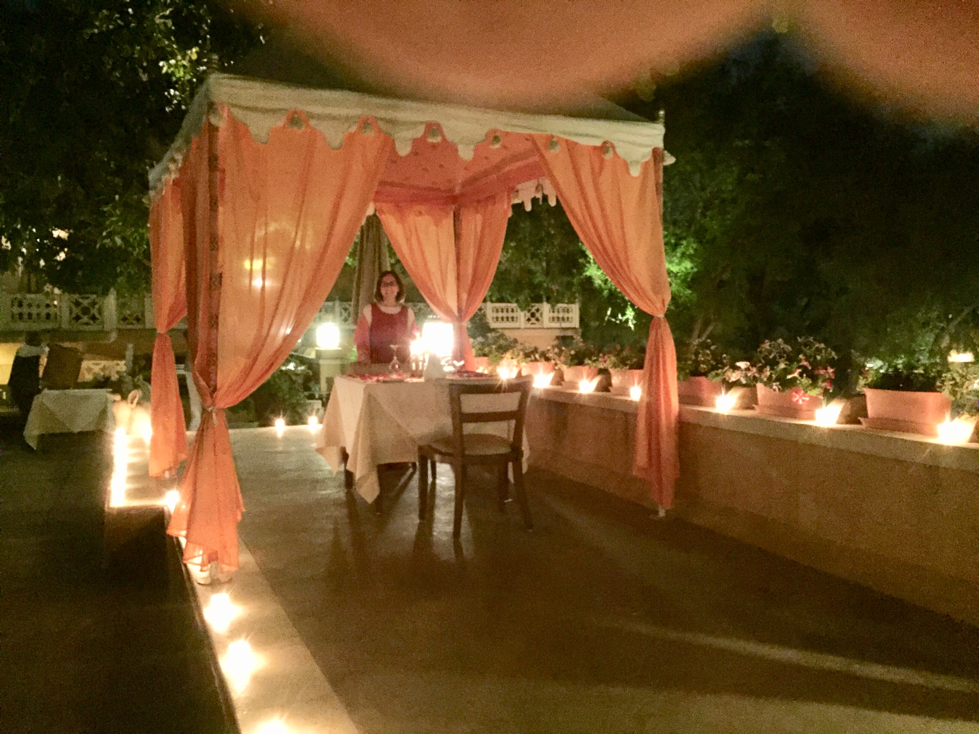
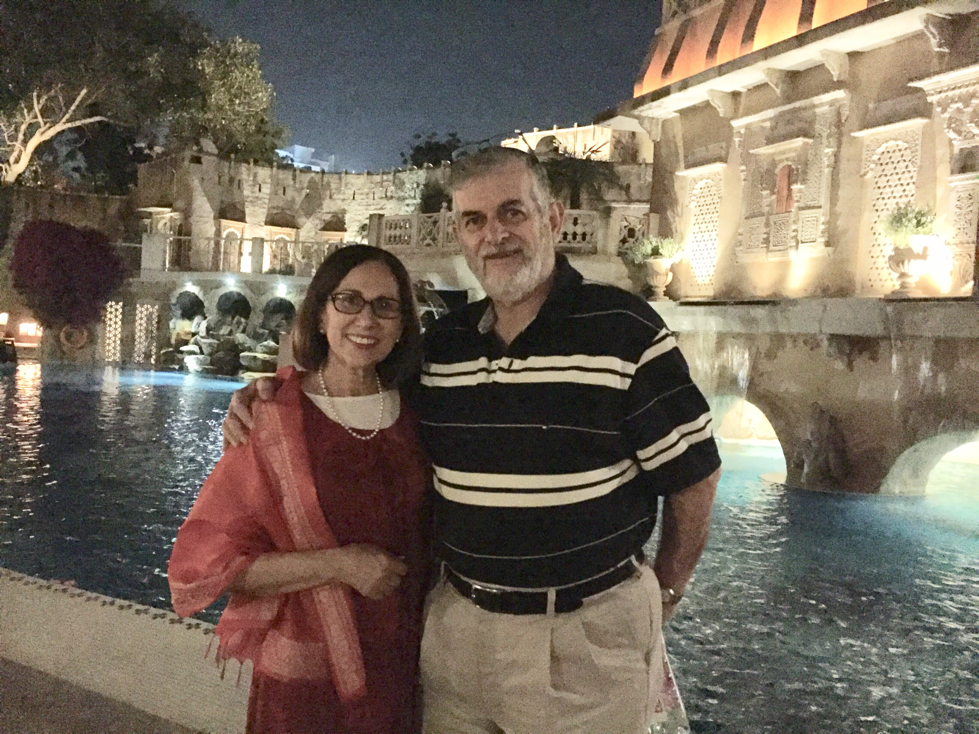
When we arrived for dinner, they showed us to the upper balcony, just opposite the magnificent swimming pool and totally separated from all the other diners. Our table was placed under a chupah like structure on a pedestal above the pool and they had lit many candles all around the area and had strewn the floor with flower petals. It was magical. We were waiting for a band to emerge playing. “od yishama”!


After dinner we decided to walk the grounds and the surrounding area and heard loud music coming from the property next door which is owned by the same Singh family. 

We walking in the direction of the singing and music and realized that an Indian wedding was taking place and so we decided to walk over and view the action. 

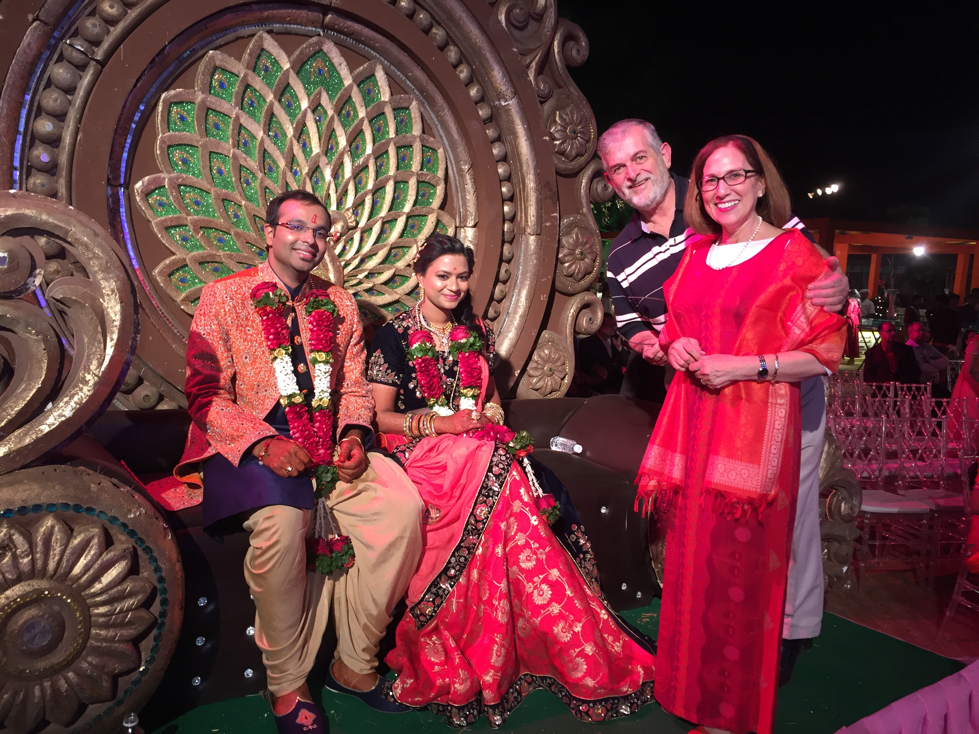
The bride and groom were seated on a platform on a intricately carved throne. They were dressed in traditional Indian wedding garb and surrrounded by seated guests, were facing a large stage. Every few minutes, members of the audience would be announced on the speaker system and would mount the stage to perform a song or dance. The performers would range from young to old and were essentially being “mesameach chatan v’kallah”. It was very loud, very joyous and very entertaining. The speaker system was what one would expect at a rock concert.


We asked the wedding photographer if we could get a picture with the bride and groom and he said certainly. Then someone from the wedding party came over and told us “do not leave...you are our guests...have a seat and enjoy the entertainment and the food!”. 

We stayed for a while and it was indeed very entertaining....almost like a Bollywood performance. Women were very elaborately decked out in the finest saris, which we were later to learn while touring the Sari market in Jaipur, could cost in the thousands of dollars. 

On Wednesday, we visited the “Blue City” of Johdpur....which I will cover in the next post.

All the best

Fran and David


Saturday, February 10, 2018

India 2018 - 4th Post - Sunday and Monday in Udaipur

We were picked up by one of the India Kosher Staff on Sunday morning and driven to the airport for our 11 AM flight to Udaipur. The flight was on Jet Airways and took about one and a half hours. Surprisingly, there was a meal ordered for us by India Kosher Travel and it was a fresh fruit platter. There are virtually no short haul flights in North America anymore with meal service. Especially meal service included in the ticket price. Here the rest of the passengers were getting a hot breakfast.   

Upon arrival, our driver Vikram, who had driven from Delhi, was waiting with a local representative of India Kosher Travel. He explained to us that we would be driven to the hotel to unpack and freshen up and at about 4 PM, a local guide, Suneel, would accompany us on a one hour drive to see a number of temples and shrines. We explained that we had seen a few temples already and were more interested in local life, how they live and interaction with the locals. As well, because of our religious restrictions on entering any temple that is based on multiple gods, it would be a drag to drive two hours to see the outside of a temple. The hotel Udai Kothi is what is called a heritage hotel, usually a former palace of some Maharaja or a luxury family villa now converted into a boutique hotel. 


We had asked India Kosher Travel to give us an assortment of heritage hotels and modern hotels during our visit and this was our first heritage hotel experience. Visually, the place was stunning. Our suite was a fourth floor walk up with no elevator. The room had a foyer with a couple of chairs and a writing desk, the bedroom had a four poster canopied bed and the bathroom was a work of art in white marble. The front door to the suite was intricately carved in wood and the locking mechanism was a heavy wooden slide bolt with an oversized padlock that was a sight to behold. You definitely had the feeling that you were staying in something quite old and historic.


But the bed was comfortable and the amenities were fine. 

The major drawbacks were trek up four floors, the very poor internet reception (I guess the Maharaja was not connected), and the proximity to the local mosque which woke the entire city up before 6 AM and then again about an hour later (if the first time was not punishment enough). 

The staff was super attentive (which we are beginning to accept as a given in India), and their cooperation with our food needs was great.

At 4 PM, Suneel showed up and we drove to the local bustling Sunday market in the heart of Udaipur. 

Suneel’s English was very good and as had been the rule with every guide or representative of the tour company, he proceeded to impress us with his knowledge of various Hebrew idioms and namedropped a number of famous Jews or Israelis for whom he had guided. 

If you have been to Machane Yehuda or to the Shuk HaCarmel, you would not be prepared for this market. It wound around a number of streets in the heart of Udaipur and consisted of fruits, vegetables, kitniyot (lentils and beans) of various types, housewares, woven baskets (actually being woven as you walked by), fast food joints of mainly deep fried sweet and spicy edibles made from wheat and chick pea flower, spices and tea and sugar cane drinks where the juice was extracted from the sugar cane as you wait. What makes it different is the lack of cleanliness, the randomness of the placement of stalls, the jostling for space as motorcycles and tuktuks speed by honking on their horns and the occasional cow, ox or water buffalo that saunters by freely. 


Everywhere we go, the people are very friendly and welcoming and there are people who want to take their picture with us. While we look at them as different, we stick out like a sore thumb. The only westerners in a sea of Indian people. And so they approach us and say “Ma’am, Sir, take a photo with you”. What is strange is that in the main, they are not taking pictures with their cameras (and most people here have smart cameras, even amongst the most poor), we are taking pictures with them on our cameras and all they want is to see the picture after we have taken it. 


A local housewares store...think of it as the Indian Home Depot or Walmart. We are in the broom department.


But it was colourful and Suneel did a good job explaining products, how they were made or grown and the origins of the various tribes who were marketing their own particular specialty. 

What has been coming very clear from every guide is that the growing of presence of Muslims in a Hindu dominated society is resented and more than once we have been told that Muslims are destructive to their society and to the world in general. More on this later. 

As we were leaving the area, for the first time we were set upon by child beggars, poorly dressed covered in filth, and sent by their well dressed sari wrapped mother who was orchestrating the scene from a distance. Our guide told us to totally ignore them and not to give them any money, which was difficult to do. 

By the time we returned to the hotel, it was almost time for dinner. This would be our first experience with food supplied by Chabad New Delhi, and we were not disappoiinted. The Udai Kothi placed us at a private table next to the swimming pool in their roof top restaurant. They did not seem to be too familiar with kosher but were ready and eager to learn and follow whatever instruction we gave. 

They brought out this huge box from Chabad which contained the food that we would have on Sunday and Monday evenings. We had chosen from the online menu of Chabad Delhi and the portions came packed in individual plastic containers. On this first night of Chabad supplied dinners, we had chicken with peppers, peas and carrots, and carrot and coriander salad. Dessert was cut up fruit. Everything was double wrapped and therefore microwaveable and was delicious. 

In the morning, after being wakened early for Muslim prayers, we went to the dining room and walked the kitchen staff thru the process of making omelettes and sunny side up eggs for us using our Chabad supplied fry pan and utensils. 

Udaipur is known as the City of Lakes or the Venice of the East as it is situated among a number of man made Lakes. It is also known as a very romantic location, because the lakes and the surrounding elevated hills make it the picture perfect backdrop for weddings. Many of these location weddings take place amidst the perfect weather of February and we arrived during a time when there was not a room to be had in the city. 


On Monday Suneel was there to take us on a walk thru the centre of town to the City Palace of Udaipur begun in the 1550s and built over a period of 400 years by the Family and descendants of Maharana Fateh Singh, who ruled the Mehar Kingdom and whose descendants still live in part of the palace. It is an intricately designed architectural wonder and assembly of 11 palaces overlooking Lake Pichola and is one of the largest and most beautiful in Rajasthan. When India declared independence in 1947, the royal family proceeded to convert the palace into a museum, royal residence and luxury hotel. 


On the way, we passed by the ever present cows in the street and a number of eating establishments with Hebrew writing highlighting that they serve great Israeli food and one even declared itself to be the choice eating place of Famous Israeli model Bar Rafaeli and her husband. 


To get to the palace we crossed one of the lakes and caught this great shot....


During the tour of the palace, Suneel explained the caste system of India, which despite being declared illegal by the Indian government, still continues unabated today, mainly because of the self imposed social pressures of families and communities to not allow the mixing or intermingling of different castes. It is quite complicated and really infringes on the the rights of individuals to succeed in the field of their choosing. It is all encompassing in its rules that relate to jobs, to dress and to status at every level of Indian society. 

Suneel also explained in great detail Hinduism and its belief system and again it was very interesting and informative. In return we tried to impart our knowledge of Judaism to him.

The palace is a beautiful huge building and is a good example of the riches that were possessed by the kings, Maharajas or Maharanas of the various kingdoms that ruled various parts of India over the centuries. After Indian Independence in 1947, the Mewar kingdom merged with democratic India and the Mewar kings lost all their royal privileges and titles but retained their ownership of their palaces, many of which have been converted into Manley making museums and heritage hotels.  


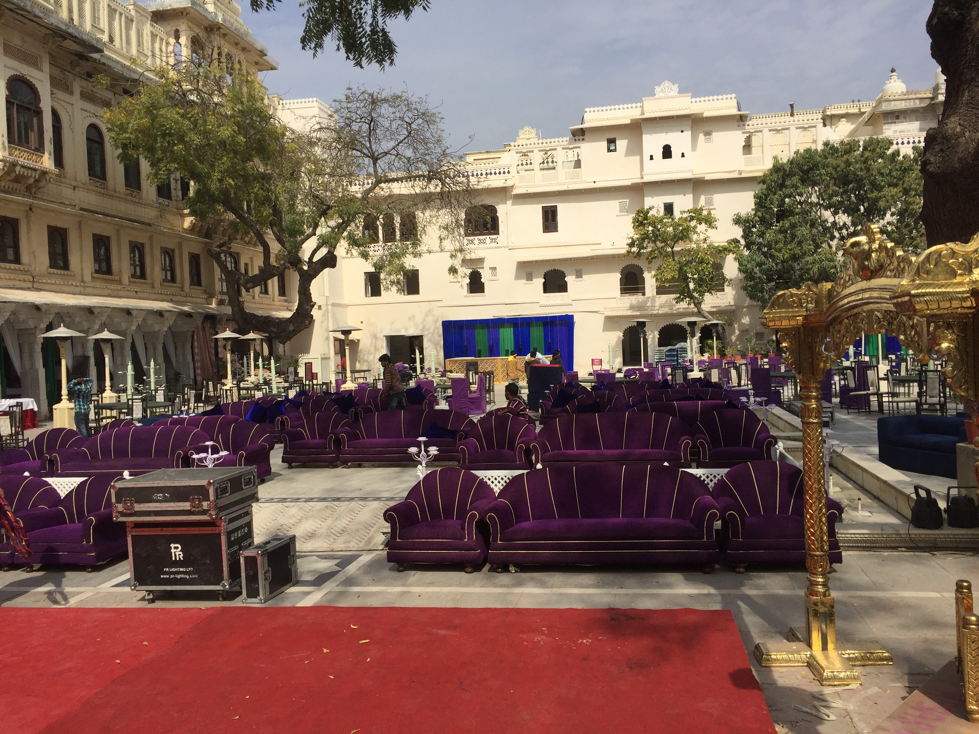
The palace courtyard was being set up for a “location wedding” that evening when over a thousand guest would party into the wee hours of the night.


One of the very interesting aspects of the palace and subsequent Maharaja palaces that we would see during our stay in India was what our friends Harvey and Achsah Weinberg told us to observe during our visit; observations made all the more timely by the impending holiday of Purim in a few weeks.

There was a palace for the king or Maharaja and a separate palace for the queen or Maharani. The king could visit the queen but the queen could not visit the king, unless summoned and then advance notice would have to be given so that the king’s advisors would have the time to exit his chambers before her arrival. When I asked what would happen if she decided to visit unannounced, Suneel’s response was “she would not do such a thing; it is not allowed”. And when I pressed and said “but if she decided to come anyway”, he said she would be punished for doing something that was not according to the rules. 

When we completed our tour of the City Palace, we took a pleasant boat ride on the lake with a stop at a small island which housed the summer palace. We then drove to a pretty park built by the Maharani where we were asked by a number of sari clad women if they could take a picture with us.


In the evening after another great Chabad Delhi meal in the hotel, we walked to a local theatre to watch traditional Indian dances and music. 

Tuesday is a long driving day from Udaipur to Jodhpur (5+ hours) but our driver Vikram has promised us some interesting stops along the way. Wednesday we will be spending the whole day touring in Jodhpur. More to come.

All the best

Fran and David