Monday, September 9, 2019

Scandinavia and The Baltics Part 8 - Arrival in Finland and on to Lithuania

It is now Sunday morning and we are leaving Sweden, and flying to Finland where we will spend two days and a bit.

We loved Stockholm, great city....so we are now looking forward to seeing Helsinki, the capital city and the largest city in Finland. But first a few basic facts:

Finland occupies a huge area of land, 15 times larger than Israel with only 5.4 million people, which means that while in Israel there are 403 people per square kilometre, Finland has 16 people per square kilometre. 
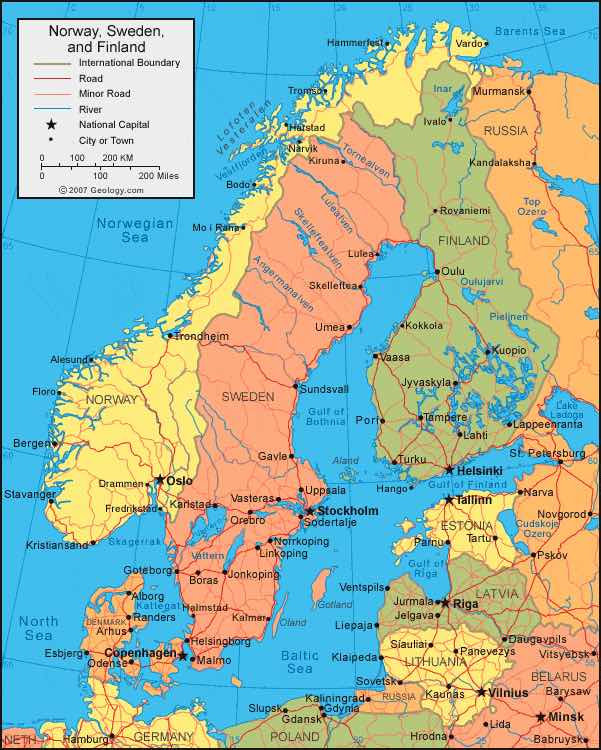

Finland is a parliamentary democracy. 

The VAT rate is 24% compared to 17% in Israel. The highest tax rate in Finland is 58%. The currency is the euro. The official language is Finnish, described by many as one of the most difficult to master. 

The time zone is the same as Israel, 7 hours ahead of Toronto.

Its flag is a blue cross on a white background. The blue represents the lakes of Finland (there are over 187000 lakes in Finland) and the white represents the snow. And when you say snow in Finland, you think of Lapland. 


People speak about Lapland as though it is a separate country when it is in fact a region of parts of four countries, Russia, Norway, Sweden and Finland; similar to how we refer to the Rocky Mountains as being part of two countries and many states and provinces. Lapland makes up about one third of Finland’s total area, with more reindeer than people. And by the way, you can now buy reindeer burgers in fast food hamburger restaurants. 

In Lapland, the sun is visible round the clock for 73 days a year, and the best place to view the northern lights. 

One clarification of something I wrote earlier. I always thought that Finland was part of Scandinavia. Officially, there are only three countries in Scandinavia, Denmark, Norway and Sweden. 

Finland is ranked first in the world for many things:
  • It is rated the happiest country in the world.
  • Per capita, Finns drink more coffee than in any other country; about 12 kilos per person per year. And in both Finland and Sweden, we noted that the availability of decaffienated coffee was extremely limited. 
  • Finns drink more milk and eat more ice cream per capita than in any other country.
  • There are 5.4 million people in Finland and there are 3.5 million saunas, more saunas than cars. There is even a Burger King that has a sauna, so you can order a burger and enjoy it in the sauna. Finns are so crazy about saunas, that on the giant Ferris Wheel in Helsinki, two of the cars are “sauna” cars. Note the darker cars at approx. 3 pm and 9 pm in the pic below; those are the sauna cars...have a shvitz with a great view of Helsinki.
  • The education system in Finland is rated best in the world, with grade one beginning at age 7. All education, including university education up to and including a master’s degree is free of charge.
  • And Finns read more books per capita than in any other country in the world.
And finally, three other interesting facts; Finns love salted licorice (Salmiakki), a confectionary item peculiar to Finland; Finns are among the most honest people in the world (in an honesty test, 12 wallets were randomly left in 10 large cities, and in Helsinki, 11 were returned to the police station, whereas in Paris, only one was returned); in Finland, speeding tickets are assessed according to your total income, so slow down or it could really cost you big time!

We arrived in Helsinki after a very short flight from Stockholm and as the Alters only decided to join on this trip after we had already booked our apartment, they were staying at a centrally located hotel while we were in an Airbnb close by. Our Airbnb was above a garage in a closed in courtyard and it was spacious and clean with full kitchen facilities. 

After unpacking, we walked to the centre of town and the port area, in time to browse the market area that services the many cruise ships that dock in Helsinki.

Our first impression of the city was that it was not as impressive from an architectural standpoint as Stockholm. Much of the downtown area appeared to be designed and built under Russian influence (boxlike, functional with little flair), which is understandable given its proximity to the former Soviet Union and its history. 

There are two huge churches that dominate the skyline, one Russian Orthodox with onion domes and the other a Lutheran church (pictured below), the dominant religion in Finland. There were letters painted above one of the doorways of the Lutheran church, spelling the name of God in Hebrew (second pic below...zoom in), and a guide later explained to us that this was a common feature of Lutheran churches. 


Perhaps the most Russian looking building was the central train station with huge concrete guards on either side of the entrance.


In preparation for this trip, we had tried to access the local kosher list; its link on the community website did not work. We tried to contact the Chabad rabbi and he basically deferred all questions to the local Rav, Rabbi Simon Livson. The Chabad house, located a couple of blocks from our apartment and one block from the port, was totally under renovation and was not accessible. 

The Finnish Jewish community is much smaller than Sweden’s, numbering about 1500 people, the majority in Helsinki. There used to be a kosher store, but in a cost saving measure they now only operate online. We brought some food with us from Sweden and dinner on Sunday consisted of the ever present jar of herring (available everywhere in this part of the world), fresh salads, with leftover schnitzel and cold cuts and a freshly prepared soup.

On Monday morning, our first stop was a 10 AM tour of the Helsinki Synagogue. There is only one in Helsinki and it is Orthodox. It is a fairly large structure and after passing security, were ushered into the courtyard which encompasses the shul, community offices and the 100 student Jewish Day School. We entered the building and were greeted by the community representative, who would be giving us our tour (5 euro per person). See below an historical picture as well as our pic of the shul.


We recognized Rabbi Livson in the office and asked him about the state of kashrut in the city. He proceeded to have his secretary print out a list for us (all in Finnish) and he translated the relevant headings so that we could take the list when shopping and find acceptable items. It was very helpful. He also clarified the status of Cafe Kippo, a vegan cafe in one of the downtown malls and, as had been the case in Stockholm, identified the problem ingredients in the cafe. 

Our tour covered the main sanctuary, (where we were given a history lesson on the Jews of Finland), the bet hamidrash, and an explanation about the Jewish School. 

One of the most interesting things that our tour guide said was that despite the fact that the vast majority of Finnish Jews are not orthodox, the shul remains staunchly orthodox out of a spirit of inclusiveness; knowing that if it were to turn conservative or reform, it would disenfranchise those few members who practised Orthodox Judaism. Here is a pic of the beautiful sanctuary from the Women’s Gallery in the shul.


Finland for 500 years until 1809 was part of the Sweden Kingdom. Under Swedish law at that time, Jews were only permitted to settle in three towns in the Kingdom, none of them in the area that we now know as Finland, and they had to convert to the Lutheran religion. 

In 1809, Sweden lost control of Finland, but because the new Grand Duchy of Finland adopted Swedish law, prohibition on Jewish settlement continued. 

In the first half of the 19th century, Jewish soldiers serving in the Russian Army in Finland, were permitted to temporarily remain in Finland after their discharge, but in 1869, there was an administrative decree that limited Jews to specific towns, specific jobs, and any violation would result in immediate expulsion.

By the end of the 1880s there were about 1000 Jews in Finland. 

When Finland gained independence in 1917, parliament approved the “Mosaic” law that allowed Jews to become Finnish nationals.

By the 1930s there were about 2000 Jews in Finland. 

Finland has always been wary of being taken over by their neighbours to the east, the Russians. So in a strange twist of fate, Finland aligned itself with the Nazis during the Finnish - Russian War or Winter War of 1941 - 1944, and Jews in the Finnish Army found themselves fighting against Jews in the Russian Army. 

Two neighbouring countries, Denmark and Norway, had already been occupied by the Nazis and the three territories of Estonia, Lithuania and Latvia had already been annexed as part of the Communist Soviet Union. Talk about being caught between a rock and a hard place. 

So the Finns chose to align themselves with Germany as the “lesser of two evils” in an attempt to protect being swallowed by Russia. The Nazis demanded that Finland hand over their Jews, with Himmler making two trips to Helsinki to formalize the demand. But the Finnish general, Marshall Mannerheim, refused and famously stated “while Jews serve in the Finnish Army, I will not allow their deportation”. He went so far as to set up mobile synagogues on the front lines and permit the local Finnish Jewish community to bring kosher provisions to soldiers serving in the army, and gave special leave to Jewish soldiers on Shabbat and Jewish holidays. He even permitted them to bring matzo and other provisions to Jewish Russian prisoners of war captured by the Finns. 

One disastrous event did occur when the head of the Finnish police permitted the deportation of 8 Jewish refugees to the Nazis; seven of whom were immediately murdered. In recognition of this terrible mistake, Finnish Lutherans established a small Christian moshav in Israel called Yad Hashmonah, the memorial to the eight. 

During the course of the war, full Jewish life  for the Jews of Finland continued as before. 

Three Jewish soldiers were awarded the Nazi Iron Cross in recognition of their bravery and all three refused to accept any award from the Nazis. 

By the end of the war, Finland remained independent and it is because of Mannerheim that the Jewish community survived. Three years after the end of WWII, in 1948, twenty seven Jews with battle experience went to Israel to take part in the Battle for Independence of the State of Israel. 

There is much more to this fascinating tale, and much has been written about it. Definitely worth a read. 

Today the shul and community centre provide a full range of services including a senior residence, youth activities, kashrut, tzedoko fund etc., as you would find in much larger communities. The visit to the shul was very worthwhile. 

One important note: you must pre-reserve by sending in a picture of your passport, as well as the time and date of your visit, or you will not be admitted. While we were there, a group of Mexican Jews, in town for one day on their cruise, tried to visit but because they had not pre-registered, were not admitted for security reasons.

One of the problems of touring on a Monday, is that all museums are closed and there are a number of interesting museums in downtown Helsinki. 

When we left the shul, we took an Uber to the port and took a ferry to Suomenlinna, an island fortress strategically situated at the entrance to the harbour to protect the city of Helsinki. It was a beautiful day and the ferry ride was refreshing. 


The Fortress was built on a series of islands that guard the harbour. Once you arrive at the main dock, there is a tourist desk that gives out a walking map, a route that is roughly 30 to 40 minutes each way. Today there are 800 people who live year round on the island, as well as a number of museums, shops, artists and a supermarket. The ferries run every 20 minutes and when the harbour freezes over in winter, the Finnish navy operates an ice breaker so that the ferry service for the island residents can continue.

We walked from one end to the other, and ended up overlooking the open sea where there were a battery of cannons and camouflaged houses within hills that housed the troops guarding the city.


When we returned we had a picnic lunch before returning to Helsinki.

After an hour browsing thru the markets at the port, we returned to the apartment for dinner and an early night.


On Tuesday morning, we did the free walking tour of Helsinki. Our guide was originally from Glasgow and he was excellent. Informative and humorous. On the way we passed the state library which has this beautiful interior. 


The weather was great, and after about two hours of walking, seeing points of interest and entertaining us with tidbits about Finnish history, customs and trivia, we ended up at the giant Ferris wheel at the port. 

One of my favourite pics on this trip was the front view of the Ferris wheel with the sun directly above.


Beside the port, there were a number of Solar Electric Charging Benches....no, not the electric chair, but rather a bench with a solar panel in the seat area, with USB charging ports along the rim of the bench. What a concept! What great Finnish innovation. 


One of the cute lines that our guide shared with us was regarding the difference between a Swede and a Finn. He said that Swedes are known as introverts and therefore when speaking to you, they will not be looking into your eyes, but they will rather be looking at their own feet. Finns on the other hand are much more outgoing, so when speaking to you, they will be looking at your feet. 

The Alters were leaving that night for Israel, so we went back to the apartment for a final lunch together for this trip and then Fran and I went out to the Design Museum, a small but very interesting museum dedicated to the art of Finnish design (see an example below). We spent the better part of an hour there and it was worth the visit.


For dinner we went to Cafe Kippo, the Vegan Place in the Forum Mall in the centre of town. We tried two of their all natural plant based sandwiches and loved both of them. Absolutely delicious. 


And then it was back to the apartment to pack for the morning Uber to the airport and our flight to Riga, Latvia and then our connecting flight to Vilnius, Lithuania. 

The main impetus for this whole trip was our interest in Lithuanian Jewry and our desire to visit the grave of my (David’s) great grandfather Rabbi Nachum Lipa Chananyah, who lived and is buried in the Old Jewish Cemetery of the small town of Vorno (Varniai), just south of Telshe (Telsai). 

In Lithuania, towns are natuarally known and signposted by their Lithuanian names. We on the other hand, know of the former Jewish life there and know the Yiddishe names of the towns. So, for example, if you are looking for Kovno, you must look for Kaunas; there are numerous such examples.

We did a lot of research about the area and the few remnants of Jewish life that remain after the brutal murder of the Jews of Lithuania and the almost total destruction of anything Jewish in the area. 

We looked at various options for shabbat and were left with two options, Vilna (Vilnius) or Kovno (Kaunas). We then read about the amazing work of a young Rabbi, Moshe Sheinfeld and his wife Ruchie who arrived in Kovno 6 years ago (when they were in their late 20’s) and established the Jewish Student Centre of Kovno to service the 50 or so Israeli students, then attending medical school in Kovno. Those numbers have now grown to almost 400 students and we felt that this would be a great place to spend Shabbat. 

So we created an itinerary of a day of touring in Vilna, and a day of touring in Kovno before Shabbat in Kovno. We would then continue to the great grandfather’s grave and spend two days touring places of Jewish interest in Lithuania and Latvia, before the final two days of our trip in Tallinn, Estonia. And to maximize our time, we hired a Vilna based tour guide originally from Israel to be our driver and guide.

After all the planning and numerous emails to Rabbi Sheinfeld, he informed us that we were in great luck, as on the Thursday evening when we would arrive in Kovno, there would be a Hachnasat Sefer Torah (Ceremony to Greet a New Torah) at the Student Centre, the first such event since the Shoah (Holocaust). 

We flew from Helsinki on Air Baltic and both flights were on Canadian made Bombardier Dash 8 twin propeller planes. Both flights left on time and were smooth. 

We had a 45 minute connection in Riga and when we got to the gate, there was a large group of Israelis who were on their way to Vilna for a tour of Jewish Lithuania. There was also an observant Jewish couple and we went over to introduce ourselves. 

It turns out that the couple was Rabbi Eliyahu and Shuly Rotenberg from Israel and he is the Rav who is responsible for the kosher supervision at the Student Centre in Kovno and they were on their way to Kovno for the Sefer Torah ceremony. 

They had been to Kovno numerous times and told us that we had definitely made the correct decision as to where to spend Shabbat.

When we arrived in Vilna, our guide Meny was waiting for us. The airport terminal was interesting, an old building that looked as though it was a remnant of the Soviet occupation of Lithuania.  


Not wanting to waste any time, we had created an itinerary with Meny that would begin with a visit to the Vilna cemetery, then to the one existing synagogue in Vilna and finally a walking tour of the Old Town of Vilna which housed the Vilna Ghetto. 

Our next post will deal with Vilna and Kovno, as well as a fascinating side trip to Alytus, where Rabbi Aaron Milevsky, grandfather of Bnai Torah’s Rav Yirmiya Milevsky, served as Rav till just before the Shoah. 

More to come....Kol toov

Fran and David


Friday, September 6, 2019

Scandinavia and the Baltics - Part 7 - Summary of Sweden

This is a summary of our observations on Sweden and specifically Stockholm. 

As we always say, 4 days do not an expert make, but these are our own personal observations and reflections, which may contain hints that will make your trip a bit easier to plan. 

1. We found the Swedish people that we met on the street to be friendly and courteous, but somewhat reserved. In other words, they did not go out of their way be welcoming but if asked, were more that eager to help. A number of times, people saw us looking at our map or iPhone and came over offering to help give us directions. 

2. Almost everyone we spoke to spoke English perfectly. The signs, though, were all in Swedish. Even in some of the touristic places, there was no written English. 

3. In general, people were dressed stylishly. We saw more men in suits or dress shirts than in t-shirts. We saw more women in skirts and dresses than in pants or jeans. 

4. There was much more modest dress than one would see in North America or in Israel; very little shorts or sleeveless, perhaps because of the colder climate, although when we were there, the temperatures were more like summer in Canada. We saw virtually no grunge. 

5. The catchphrase that all four of us had after a couple of days in Sweden was “the people here are all slim, tall, leggy, blonde and beautiful”. The men and the women!

6. Sweden is quiet. That is a funny way to describe a country, but we found it quiet ....the people in the streets, on the subways, in shoppes, were all quiet and reserved. Not to the same extent as in Japan, but quiet nevertheless.

7. The majority of the buildings were old and well preserved, well maintained. And while the outside was clearly old, the insides were modernized to a very high standard.

8. The sidewalks were well maintained even though they were formed with paving stones, nothing was uneven, nothing out of place. And when something needed repair, that area was roped off as the renovations proceeded. When buildings were being refaced or new buildings erected, there was a gauze barrier so that the repairs were cut off from view or perhaps to ensure that no debris fall into the path of passersby. 

Our only word of caution here is that in the Old Town of Gamla Stan, in order to preserve the authenticity of the place, they have retained the early cobblestone streets. And these are really cobblestones that are hard to walk on unless you are wearing very comfortable thick soled shoes...still well maintained but harder on the feet. 

9. There are very clear markings of car lanes and bicycle lanes. There are pedestrian crossings everywhere. And even though there are traffic lights, cars seem to always give way for pedestrians. If you look like you are waiting to cross the road, an oncoming car will slow down and yield to you so that you pass unhindered. Almost no one uses their horn.

But when it comes to cyclists of all types, they believe that they are king. So if you are trying to cross the road and you have to cross over a cyclists’ lane, be careful...they will not yield. 

10. There are signs everywhere about conservation, the green movement and the need to recycle. Clearly the Swedes are into conservation; many of the cars were electric and there are government subsidies if you purchase an electric car. We even had a ride in an Uber Tesla....very smooth and comfortable ride.

11. We for the first time saw the emergence of a cashless society in Sweden. There were a number of places, even tourist spots that would no longer take cash. Imagine not having a credit card and coming to a museum that refused your payment because it was cash? Well, we experienced it and even experienced it in a small coffee shop in Vaxholm. Credit is king!

12. As we have done in many cities we took advantage of the Free Walking Tour. There are 4 tour companies in Stockholm offering the free walking tour. We chose ours by the Trip Advisor reviews. It was great and if you are pleased, you simply leave a tip for the guide. Our tour took us through the Old City Gamla Stan. 

13. You really have to be lucky with the weather and we certainly were. In early September in Sweden and Finland, you can experience cold weather, but we had absolutely beautiful weather, perfect for walking and touring. Our only cloudy cool day was the afternoon in Vaxholm but otherwise it was perfect. 

14. Scooters and Segway - when your feet begin to ache from all that walking, you have a number of options as to how to tour the city or to get from place to place. 

We took a Segway tour of the new part of Stockholm and in two and a half hours we covered a lot of ground with little wear and tear on our legs. This was our second Segway experience and it is either a result of experience or improvements in the machine, but it was easier the second time around. We will certainly consider doing this again in other cities. Not sure if Irving has the same feeling.....

The other emerging mode of transit that seems to have taken off in Stockholm is the electric scooter. Similar to the way the city bike system works, where you can pickup a bike in one place using an app and returning it to another place closer to your destination, the scooter system has one advantage or disadvantage. With the scooter, there are no depots (the advantage).  You pick one up whenever you see one, and drop it off whenever you are finished with it, sometimes in the middle of a sidewalk or a pedestrian walkway (that’s the disadvantage). 

These are available in many cities, including Tel Aviv, and other cities, Toronto included, are considering their introduction but are hesitant as there are no established rules of the road yet for the scooter; can you use them on sidewalks?....or only in bike lanes? In Stockholm where you have bike lanes everywhere, their introduction has been seamless. In Toronto, they will introduce it limited to the Distillery District and if it works there, will expand its use to other areas of the city. 

15. We felt very safe in Stockholm. From a personal safety standpoint and Jewishly. There are signs everywhere warning about pickpockets and took the precautions that everyone should take in any big city. But we never felt threatened or feared for our safety anywhere. 

I (David) brought a hat with me because we were warned that wearing a kippa was dangerous. But I wore a kippa everywhere and never once felt that my safety was being compromised. We received conflicting comments by members of the Jewish community. Most men leaving shul took off their kippot. Many said that “one does not wear a kippah in the open in Sweden”. But others told us that as long as we were in the central part of the city, where tourists hang out, we should feel safe and a kippah would not be dangerous. 

Some of the women in shul on Shabbat told Ruchama and Fran about their children being harassed in their schools because they were Jewish and those women said that they would not want their children to wear kippot or a Magen David for fear of being harassed. 

Not sure what is right but BH we were safe. 

16. Kosher list & app - in preparing for this trip, I downloaded the Swedish Kosher List. As you know, like most European countries, there are few items with a kosher symbol on the product. And so you have to rely on the list. The list consists of those few items that are actually under Hashgacha and the many more items that the local rabbinate has determined onbe kosher without actual supervision. 

Closer to the actual date of departure, I was in touch with the local Orthodox Rabbi, Amram Maccabi, who informed us that there was now a kosher app, which when downloaded on your device, could scan the bar codes of products and let you know the status of the product. 

When we arrived, we tried it out on a number of products that we knew to be kosher and the app did not work. 

When I met the rabbi in shul on Friday, he informed me that he was the one to develop the app and that the app had been down for the past three days but was now back online. The app has 3000 barcodes thus far. Great concept. 

17. The Swedish community with its Orthodox rabbi has also four options for eating out. 

There is a cafe in the JCC, called the Bajit, which is generally open all day till 6 pm (check first), where you can have a light dairy meal. We went the first night we were there and enjoyed our meal. 

The Bajit Cafe is under the hashgacha of the Rav. The other three options (Vegan Schmegan, Herman’s and FLFL) are all vegan or vegetarian options and do not have active hashgacha; the Rav has checked all the ingredients and processes and has indicated the few ingredients that might present a problem. As a result, before going to any of these eateries, one should check the kosher list to see the exclusions. All three are owned by Jews and/or have Jewish chefs and as such the issue of bishul akum is addressed. 

There is also a kosher caterer in town who will cater all your food needs and deliver them to your hotel, and then there is the ever present Chabad which offers Shabbat meals. 

There is also a line of kosher supervised Mediterranean salads called BABA Foods, widely available, as well as a variety of kosher breads and crisp crackers like WASA, and a large variety of kosher herring and smoked salmon. Bottom line, you will not go hungry in Stockholm. 

18. Stockholm is expensive. Everything from taxis to food costs to admission costs to souvenirs was expensive. But the beauty of the city and easy access to everything should still make this a city worth visiting. 

19. And finally some words about Jewish life in Stockholm. Our impression of the community is that this is a community that is very proud of their Swedish roots and their Jewish history but is also a community that sees itself under constant threat. One community member told me that ten years ago, there were 17000 Jews in Sweden and 40000 Muslims; today there are less than 17000 Jews and 400,000 Muslims. There have been many anti Semitic incidents in Malmo which has a huge Muslim population and many less incidents in Stockholm. As a result of the anti Semitic attacks, every aspect of Jewish life is contained unfortunately within a fortress. 

In order for a visitor to enter into any of the synagogues or the Jewish Centre, one needs to pre register by email with copies of formal identity. 

There is a large Jewish school in Stockholm but because it relies on Government funding, it must accept non-Jews and is afraid to allocate more than one hour a week to Jewish prayer for fear of losing its funding. So while elderly locals are comfortable at leading the services in the synagogue, the fear is that the younger generation will not be able to continue with those same traditions and level of familiarity of the prayers and modes of observance. 

Estimates of the Jewish population of Stockholm itself are around 14000 (it is impossible to know exact numbers of Jews as the census in Sweden forbids ethnic registration), but only 4500 are registered with the formal Jewish community. 

Swedish Jews have strong ties to Israel and many have made Aliyah. Will this continue? Will the community survive? Impossible to know, but history has shown that when the Jewish education is weak, the community can begin to see the writing on the wall. 

20. Our conclusion after 4 and a half days in Sweden was that this is a place worth visiting. We fully enjoyed our visit there and now we are off to Helsinki Finland. 

More to come....Shabbat Shalom

Fran and David


Wednesday, September 4, 2019

Scandinavia and the Baltics - Part 6

A few words about shabbat observance on the road. 

When we booked the apartment in Stockholm, we asked that it be on a low floor and inquired about stair access and the type of keys being used. What we did not know is that in Stockholm there is really no such thing as a high floor. It seems that the height of all the buildings in the downtown core were limited to 4 or 5 floors. 

They replied that there was stair access and that they used normal keys rather than key cards. When Irving and Ruchama  booked their apartment in the same building, they were told the same thing but with one addition; that the front door locks automatically and there is an automated key pad that allows access. We figured that this would be a problem but that once we got there we would figure out a way around it. 

But fortunately when we all arrived, Irving noticed that in addition to the keypad, there was a key lock on the door (presumably used before they installed the keypad). So we asked the superintendent and he confirmed that there was a key and that he could provide one to us. Problem solved. 

There is no eiruv in Stockholm so we had to make sure that we left everything behind except for my Shabbos belt, to which the keys to the building were attached. 

Davening at the Adat Jeschurun in Stockholm was at 9 AM. Being a short distance away, we left for shul around 8:45 and were among the first to arrive. There was a steady stream of people coming to shul and by the time davening ended, there were about 100 people in shul, evenly divided between men and women. 

There were two birthdays in shul; one for a 92 year old man and the second for a 90 year old man who had recently made Aliyah to Jerusalem but who returns to Sweden during the summer because of the more moderate temperatures there. The shul was honouring him this shabbat with a kiddush celebrating his birthday and his years of service to the community. 

He received the Aliyah for maftir and as I was laining, he turned to me and asked if he could lain. He lained wonderfully and then proceeded to chant the haftarah and also daven mussaf for Shabbat Rosh Chodesh with perfect nussach, a melodious tune and strong voice. It was a pleasure. 

When we finished davening, we went to the main floor for the kiddush and before kiddush the honouree spoke (in Swedish), made kiddush and hamotzi and we all enjoyed cakes, cookies and cold cut sandwiches.

While we were in shul, we had two doctors look at Irving’s leg and the message was that if the pain and swelling would continue, he should get it checked out by a physician. 

We also had the chance to speak with a few locals and get a better understanding of Jewish life in Sweden. More on that when I do my summary of Sweden in a future post. 

We returned to the apartment, ate Seudat Shabbat, slept and then went for a late afternoon walk, exploring more of Stockholm in beautiful warm summer temperatures. There is no Shabbat afternoon minyan in Adat Jeschurun; there is one at Adat Jisrael but given that it was a 40 minute walk and I did not have an accurate address or directions for the place, I opted to daven at the apartment. 

And after havdalah, we packed our things up, having spent a wonderful 4 and a half days in Stockholm, and prepared for our flight on Sunday to Helsinki, Finland. 

Sorry...no pictures on Shabbat!

More to come

Fran and David

Tuesday, September 3, 2019

Scandinavia and the Baltics - Part 5

Friday morning saw us once again at shul with close to 20 attendees, where we met the Rabbi of the community, Rabbi Amram Maccabi. He has been the rabbi for a number of years of both Adat Jeschurun where we have been davening and Adat Jisrael and previously had been the Rav in Halifax, Nova Scotia. He was now completing his tenure in Stockholm and returning to Israel with his family. He told us that he would see us that evening, but would be davening on Shabbat morning at Adat Jisrael, the sister Orthodox shul on the other side of town. 

Adat Jeshurun has quite an interesting history. There was a shul founded in Hamburg, Germany in 1780. It was one of the oldest Shuls in Hamburg’s inner city. 

On November 10, 1938, on the night known as Kristallnacht, virtually all the Shuls in Germany were burnt and destroyed. This little shul survived Kristallnacht as it was located in a downtown apartment block and the Nazis did not want to cause harm to non Jews. 

The Chief Rabbi of Hamburg at the time was Rabbi Dr. Joseph Carlebach (pictured below, an Uncle of the famous Shlomo Carlebach). He took it as an omen that the shul had survived and fearful of what was lying ahead for the Jews of Germany, wanted to secure its existence. So he contacted an old friend, Hans Lehmann, who had recently moved to Stockholm and asked him if he would be willing to take the furniture (the pews, the Aron Kodesh, the bimah etc) and the siddurim, talitot, and tefillin, and transfer it to a shul in Stockholm. Lehmann agreed and Carlebach secured an export license, identifying the interior of the shul as “old junk”. Everything was dismantled, boxed and sent to the port for the voyage to Stockholm. 


When the shipment arrived in Stockholm, it was a frightening sight. Everything was destroyed with swastikas all over the boxes. Lehmann, accepted the delivery, personally hired craftsmen to rebuild and repair everything and created a new home for the former shul in Hamburg, the new shul called Adat Jeschurun in Stockholm. 

The shul was consecrated in 1940. As Shuls were being destroyed all over Europe, in Stockholm a new shul was created. 
Unfortunately Rabbi Carlebach did not survive the war; he was murdered by the Nazis outside Riga in March 1942.

Over the years, the shul had to move numerous times and each time the furniture from Hamburg moved with the shul. Sadly, in 2013, the building housing the shul and the school was demolished and a new building was built for the school with no permanent home for the shul. So the shul till today is housed in temporary premises in the new school building but all the furniture that had survived had to be put into storage. 

In speaking to a number of members of the shul, there is a clear determination to rise again and create a permanent home for the shul at some time in the near future so that the furnishings that the Nazis failed to destroy continue to live and serve the Jews of Stockholm.  

We also discussed with some members the status of the Jewish School. It has about 350 students, but because all schools in Sweden must be public, the funding of the school could be in jeopardy if it refused to accept non Jews and also if there is too much of an emphasis on the Jewish religion. So as a result, there is only one hour of Jewish prayer a week in the school and it is optional, meaning that the student would have to opt in. Very few of the students wear kippot in the school building. 

On our way back to the apartment, we stopped by the bakery to buy breads for Shabbat, and we experimented with a couple of artisan breads, that we later discovered had fruits and nuts inside...kind of a Shabbat surprise for us when we cut into them.

Our schedule in the morning was a Segway tour of the city and so we walked the 15 minutes to the meeting point. 

Stockholm is an amazing place because of its walkability. It is relatively flat, and nearly all the tourist points of interest are within walking distance. There are bike lanes everywhere and many people are using bikes or scooters as their mode of transportation. 

We met our Segway leader, a young nursing student originally from Albania. Besides the four of us, there was another couple, who hailed from Woodstock Ontario. They were on a cruise. It seems like everyone we met during our stay in Stockholm was on a cruise. The amount of cruise traffic involving Stockholm, Helsinki, Tallin and Copenhagen must keep the tourist trade alive in the Baltic region. 

We went through a brief training session and then off we went on our Segways exploring the city. Every few blocks we would pull over to the side and our leader would share something about Swedish society and history or point out an interesting tourist site. She was very good and very professional. The ride was quite easy as well because of the designated bike/scooter/Segway lanes in the city. 


One of the very interesting places that she showed us was the source for the term Stockholm Syndrome, a psychological condition which causes hostages to develop a positive alliance with their captors during captivity. 

This term was first used by the media in 1973 when four hostages were taken during a bank robbery at the Kreditbanken (pictured below) in Stockholm. The hostages defended their captors after being released and would not agree to testify in court against them.

A very famous example of this syndrome was the Patty Hearst case with the Symbionese Liberation Army one year later in 1974. 

Another interesting stop was at a statue outside the National Theatre. If you put your hand on the bronze statue, it is warm. 

It is a statue of Margareta Krook, a famous Swedish actress.

During her life, Krook was approached with numerous proposals for statues to be built in her honor, but declined them all, stating that statues are cold and uninviting. However, after her death, the theater wanted a statue but they did not want to go against her wishes. The theater found a loophole that technically allowed for a statue and was in line with Margareta’s wishes: a heated statue. 


Especially during Stockholm’s cold winters, the statue provides warmth to everyone who passes by.

One of the other interesting spots to which we rode was the Stockholm City Hall, where the Nobel Prize Ceremony is held. 


The Segway tour was great. Unfortunately, on our way back to the office, Irving fell while trying to get off the Segway and badly bruised his leg. That caused Irving and Ruchama to cut short their touring for the day and to remain at home for the rest of the day and evening. 

Fran and I continued with the plans for the rest of the day which was to tour Stockholm’s longest Art Gallery. There are 100 subway stations in Stockholm and when they built the stations, they decided to make them interesting. Most of them have an artistic theme and using an online guide, we purchased two subway tickets and spent the next 90 minutes traveling the subway system and taking photos of this most unique subway system. Many of the stations have been left with rough hewn rock and some of them are extremely colourful. It is well worth your while if you visit Stockholm to take this self guided tour.  


We got home a few hours before Shabbat and we prepared our meals for Shabbat. But before going to shul that evening, we had one more interesting stop.

One of the most beautiful sights in Stockholm is the Great Synagogue, which is a conservative Synagogue. We had noticed that the shul would be open for Friday night services at 6:30 PM while Adat Jeschurun would have Kabbalat Shabbat at 7:30 PM. So we decided to go first and have a look at the Great Synagogue and then drop off our camera and passports at home before candle lighting and before proceeding to shul.


It was well worth the visit. Truly one of the most beautiful sanctuaries that we have ever seen. 

I went to Adat Jeschurun myself and was honoured with leading Kabbalat Shabbat. There were about 15 men and one woman there. We were told that for Shabbat morning, there would be a much larger crowd because of a kiddush honouring one of the members who was turning 90 years old. 

I returned home to the apartment and we had a very wonderful Shabbat meal, followed by a wonderful long Shabbat sleep.

More to come

Fran and David


Monday, September 2, 2019

Scandinavia and the Baltics - Post 4

On Thursday morning, we once again headed to shul and this time, there was a minyan, about 17 of us in total. Some of the men had heard that I had this thing about wanting to lain in every country that I visited, so they asked me to lain. 


We came back to the apartment, ate breakfast and headed over to the Vasa Museum.

The Vasa was a huge war ship built between 1626 and 1628 in Sweden on the orders of King Gustavus Adolphus as part of his military expansion in the war he initiated with Poland and Lithuania. This was meant to be his flagship and was meant to be a symbol of his power and influence over all of Europe. But the shipbuilders had never before built such a ship and while it was huge, with many decks filled with canon firepower, the ship was unbalanced and unstable. In its maiden voyage, just about 1000 metres out into the sea, a mild wind tilted the ship and it sank. Many died in this terrible accident. A message was instantly sent to the king who was fighting a war in Poland but he did not receive the message for two weeks. 


The Vasa lay on the floor of the harbour for close to three and a half centuries until it was raised in the 1960’s. It was stored in a warehouse until a suitable spot could be found to display this well preserved relic.

In 1990 the Vasa Museum was opened where the full size original Vasa stands. Since the opening of the Museum, there have been close to 40,000,000 visitors. We opted for the English tour, given a number of times daily, and it was well worth it to hear the explanation of the boat and the events surrounding its construction, its magnificence and its ultimate failure. There is also a movie that shows exactly how they raised the wreck from the ocean floor.


When we finished touring the Vasa, we walked past the kosher street food truck (Vegan Schmeegan), and caught a tram to the docks, where we caught a ferry to one of the many islands surrounding Stockholm, Vaxholm. 

The weather up to this point had been awesome but now it turned cloudy. So the ferry ride to Vaxholm was a bit of a downer. The little island Vaxholm, and the town of the same name are very quaint with brightly coloured houses, many boutiques and coffee shops, and if the weather was better, it would have been a better afternoon. So we cut our time in Vaxholm in half and took the bus back to Stockholm. 


We went back to the old city and returned to one of the stores we had seen the first day - a pop up store by a Swedish artist, where we saw some very interesting items. 


At the same time, we were told by a policeman who we met in the Old City that there was a new Jewish Museum in the Old City and that it was located near the massive German church. 

We could not find it so we went to the church and asked them where the Jewish Museum was located. Thank God they knew. The place had a very interesting history. 


It was located at Själagårdsgatan 19, in a building that was originally a shul in 1795. When the congregation vacated the premises in the 1870s, it was taken over by the Seaman’s Church, who retained the bimah and Aron Kodesh to be used in their services. 


When they vacated, it became a Police Station and the Police Commissioner, who happened to be Jewish, recognized that it was an Aron Kodesh. He arranged for it to be transferred to storage at the Nordic Museum where it remained until it was returned to this small and interesting new museum that just opened its doors this past June. The Museum shares much of the history of Swedish Jewry with many historical letters and features about its founders and significant leaders. 

And had the policeman not told us, we would have never visited this absolute little gem. 

We returned once again to Herman’s for a vegan dinner and once again it was delicious. This time we also shared a vegan dessert pie which was absolutely outstanding. 


Tomorrow is Erev Shabbat in Stockholm....more to come

All the best,

Fran and David