A word about Airbnb’s on this trip. We stayed only at Airbnb’s and for the most part, they were excellent. Location in every case was great, most had every convenience that we were looking for, most had washing machines, so we did not have to pack as many clothes and they all had cooking facilities so that if there was no place to eat out, we would be able to make our own food.
One thing to be aware of when travelling to Scandinavia and the Baltics, is that while air conditioning is pretty standard and expected in most places in the world, in this region, it is a rarity. In a heat wave, they will supply a fan. Thankfully, there was no heat wave while we were travelling.
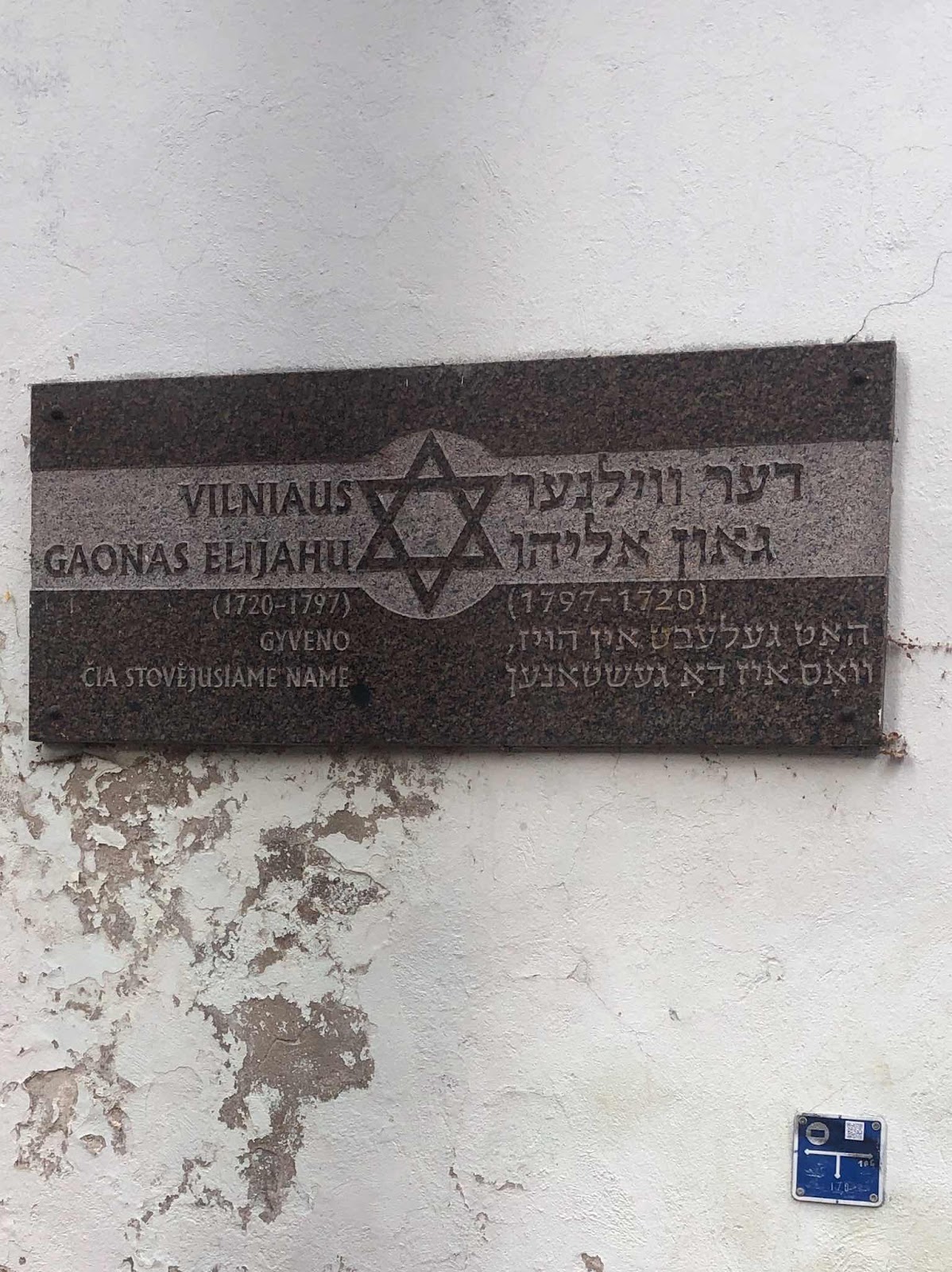
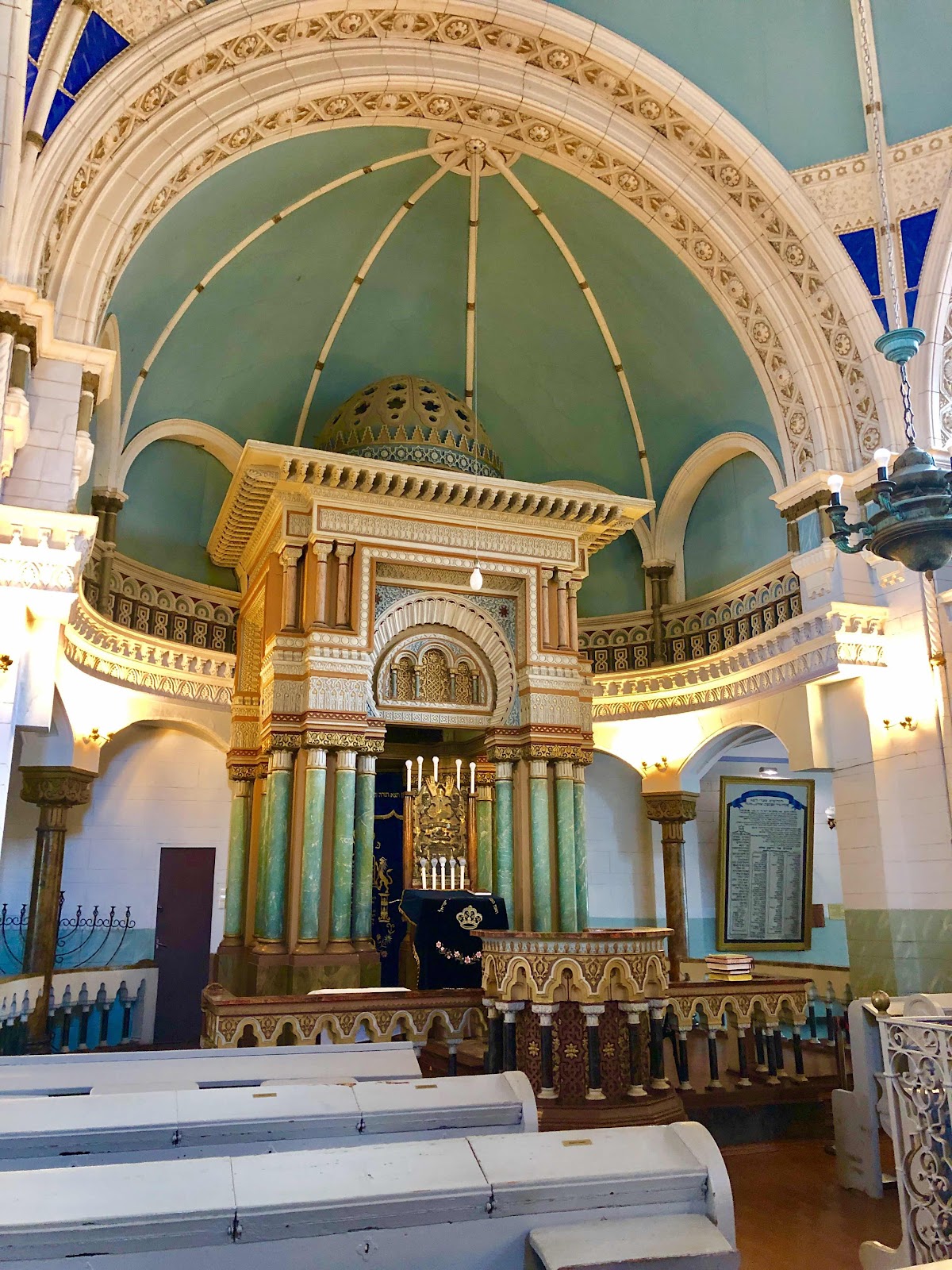
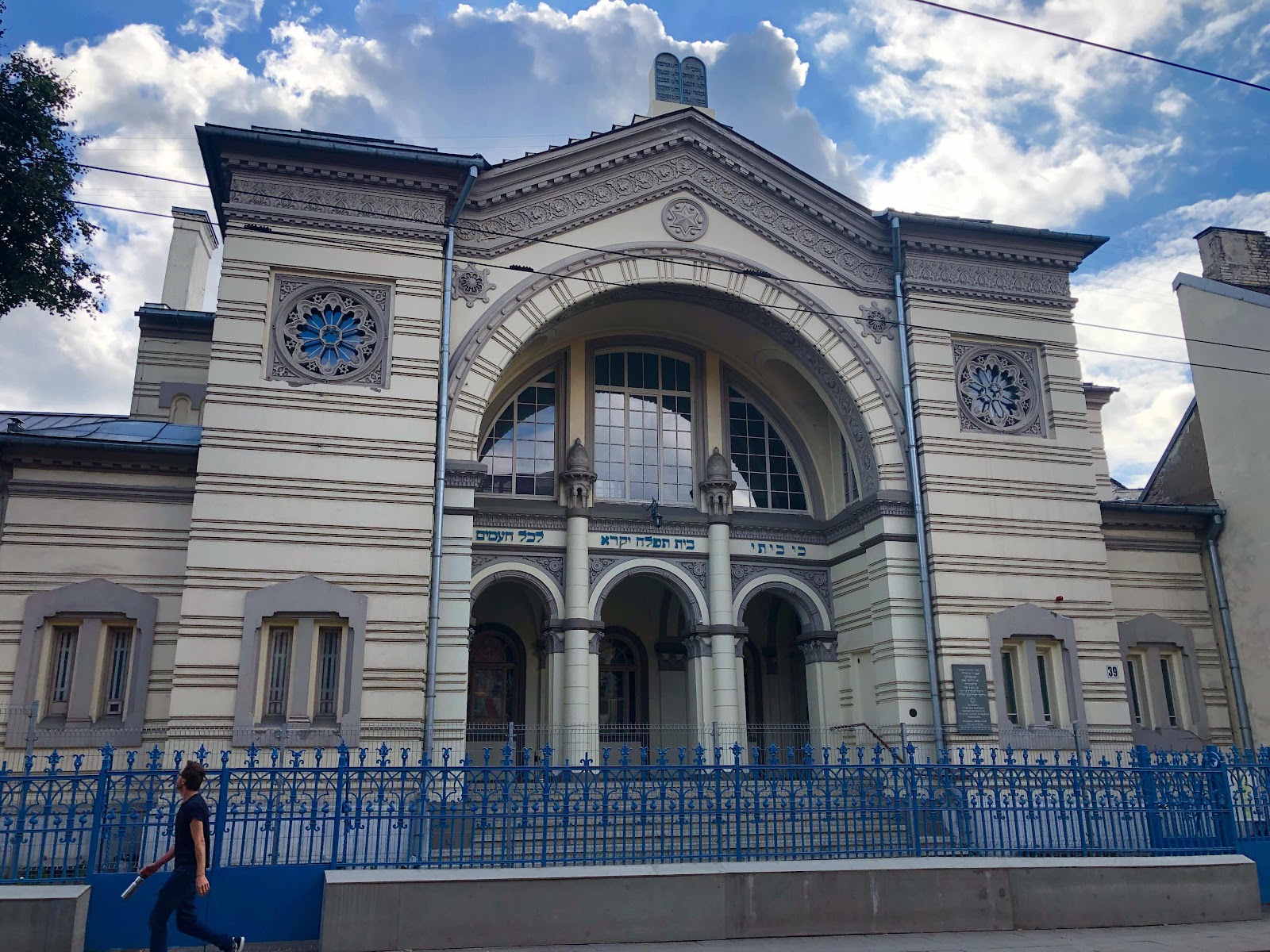
The Airbnb in Vilna was likely the best we had ever stayed in. When we opened the door to the building, the hall and staircase looked like it was from pre WWI. But then when we reached the second floor and opened the door to our unit, it was like we walked into a designer decorated apartment with every modern convenience and every amenity one could think of. Prices were amazingly low and we really felt that we got good value for our money.
Meny picked us up at 9 AM and we were off the the Panery Forest.
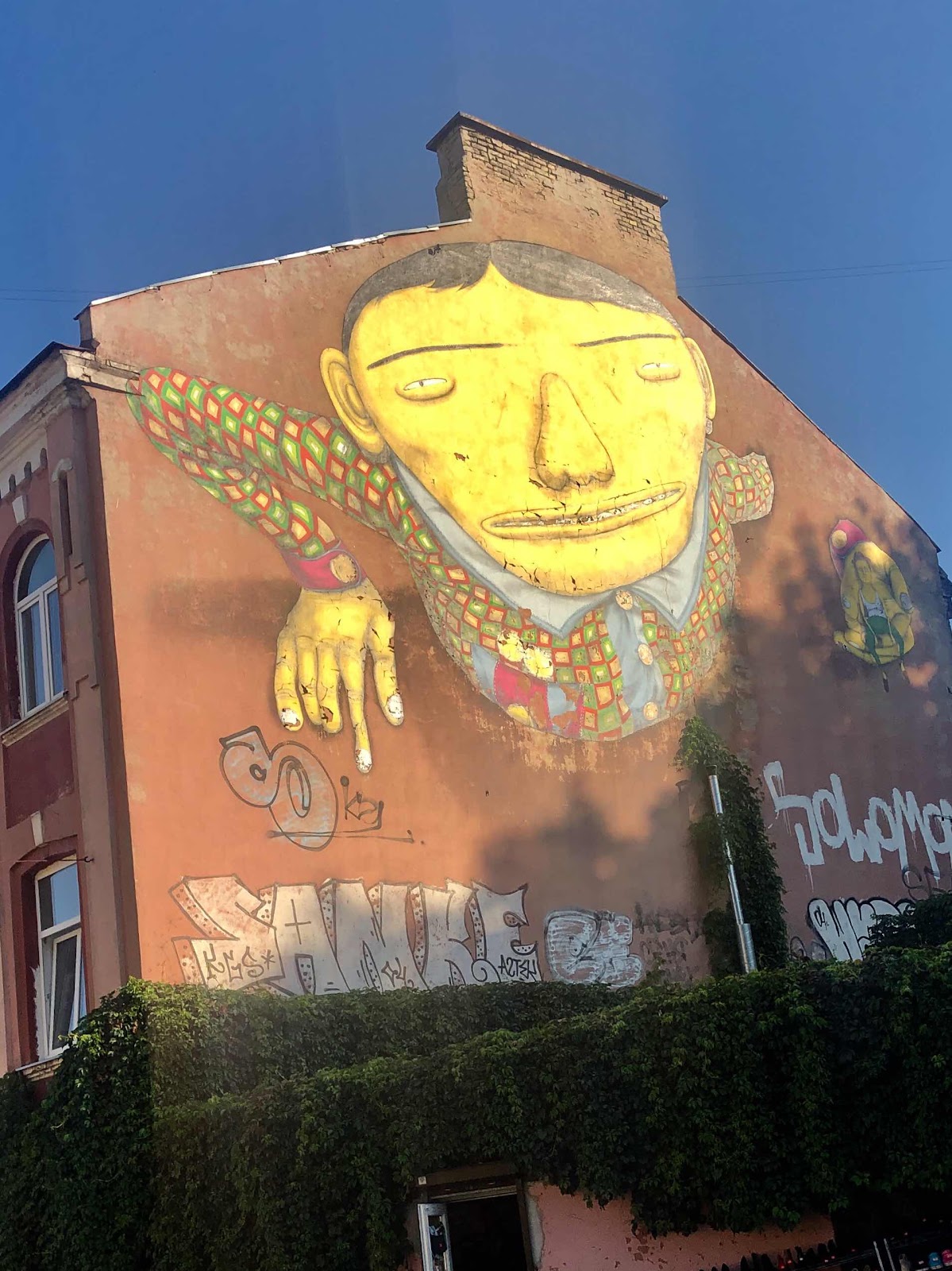
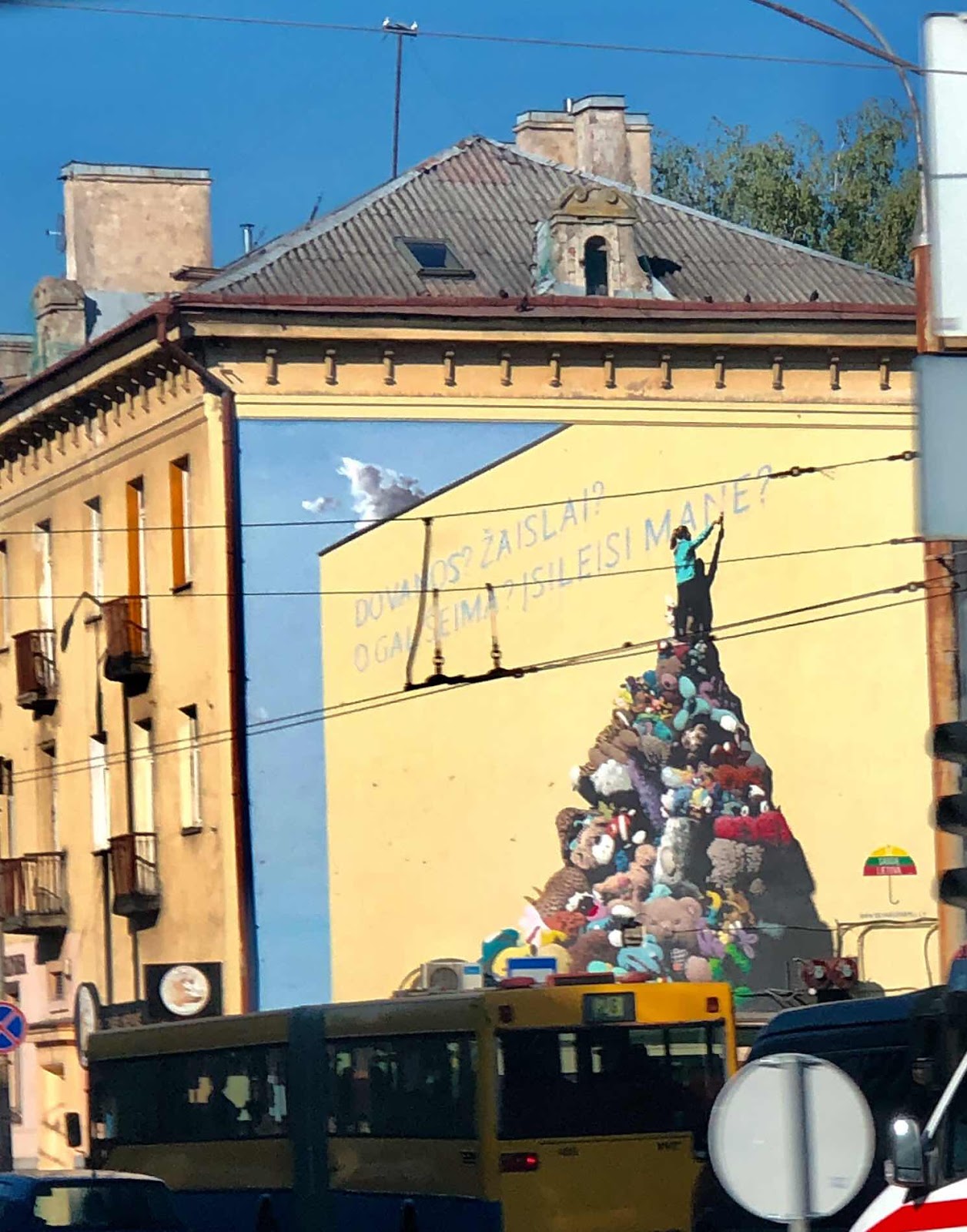
On the way, we passed some of the “street art” that is emerging all over Lithuania.
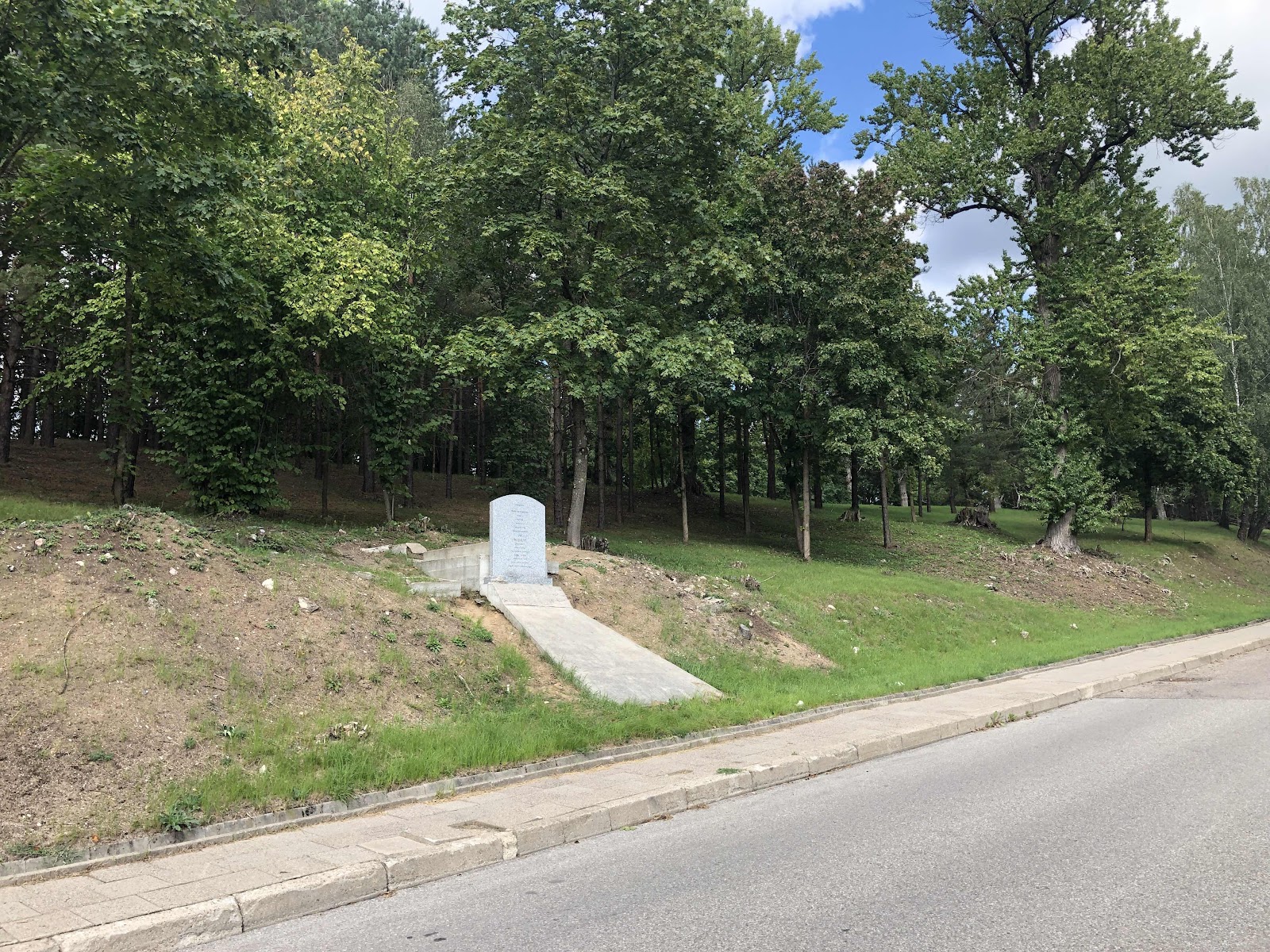
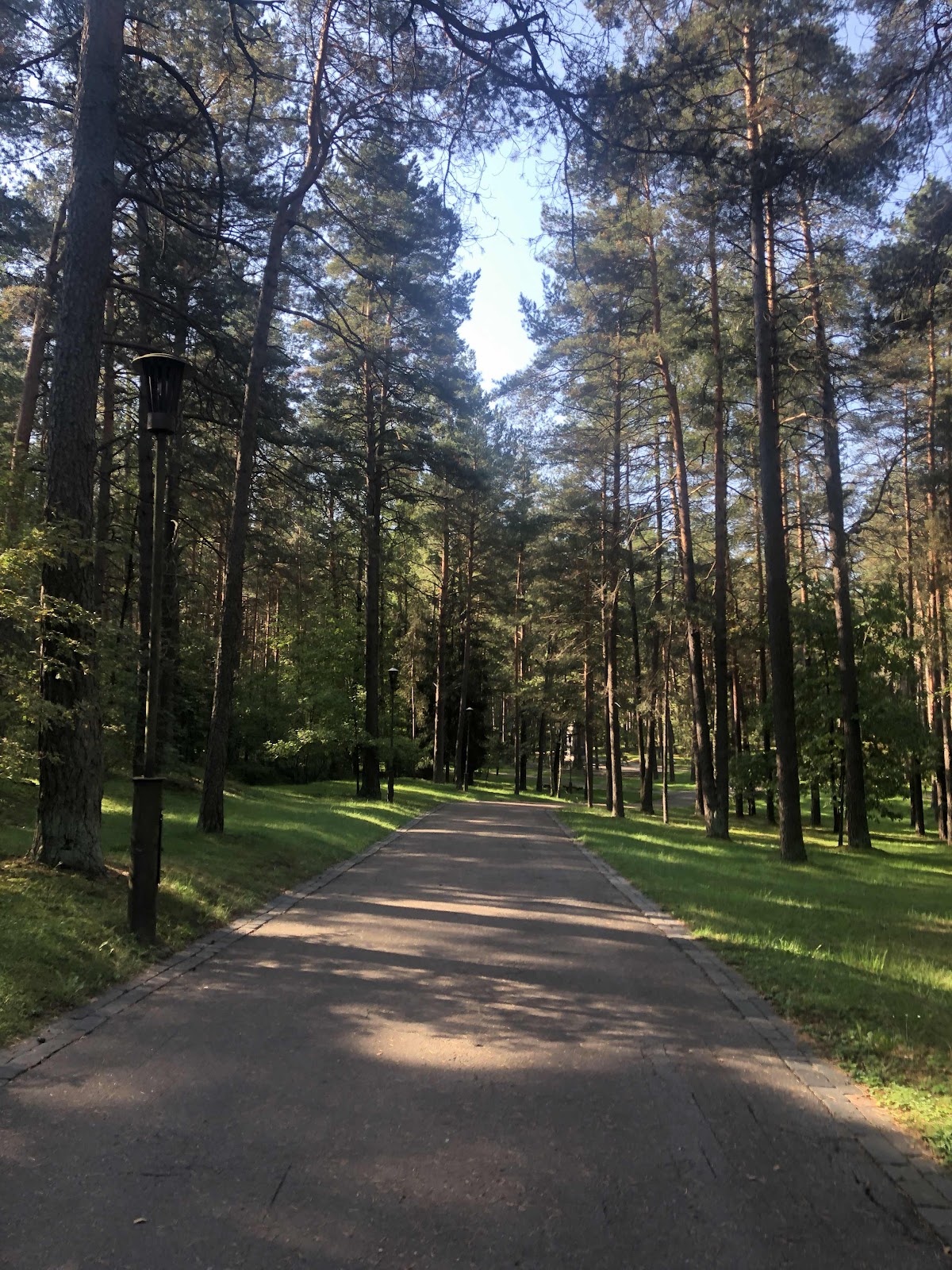
This forest was once the favourite spot for people to go on their day off. It is a quiet forest, the ideal place to commune with nature, tranquil, serene!
Following the Soviet annexation of Lithuania in June 1940, plans were laid to establish a military airfield in the area. The Soviets dug six enormous pits into which they planned to store oil for the airfield. The project was never completed and in June 1941, the area was overrun by the Wehrmacht and the Nazi killing squads decided to use these pits to abduct, murder and hide the bodies of their victims.
Between July 1941 and August 1944, this was the site of the mass murder of 100,000 people, 70% or 70,000 of whom were Jews, most of them from the Vilna Ghetto. This was one of the first sites outside occupied Poland where Nazis mass murdered Jews as part of the Final Solution. The first people to do the killing, the people actually carrying out the murders were Lithuanian volunteers!
One of the pits was used later in the war as the “holding cell” for 80 Jews, who were tasked with burning the bodies. They lived in the pit and daily went about their job burning bodies. A group of these people eventually dug a tunnel in an attempt to escape the atrocities that they were asked to perform.
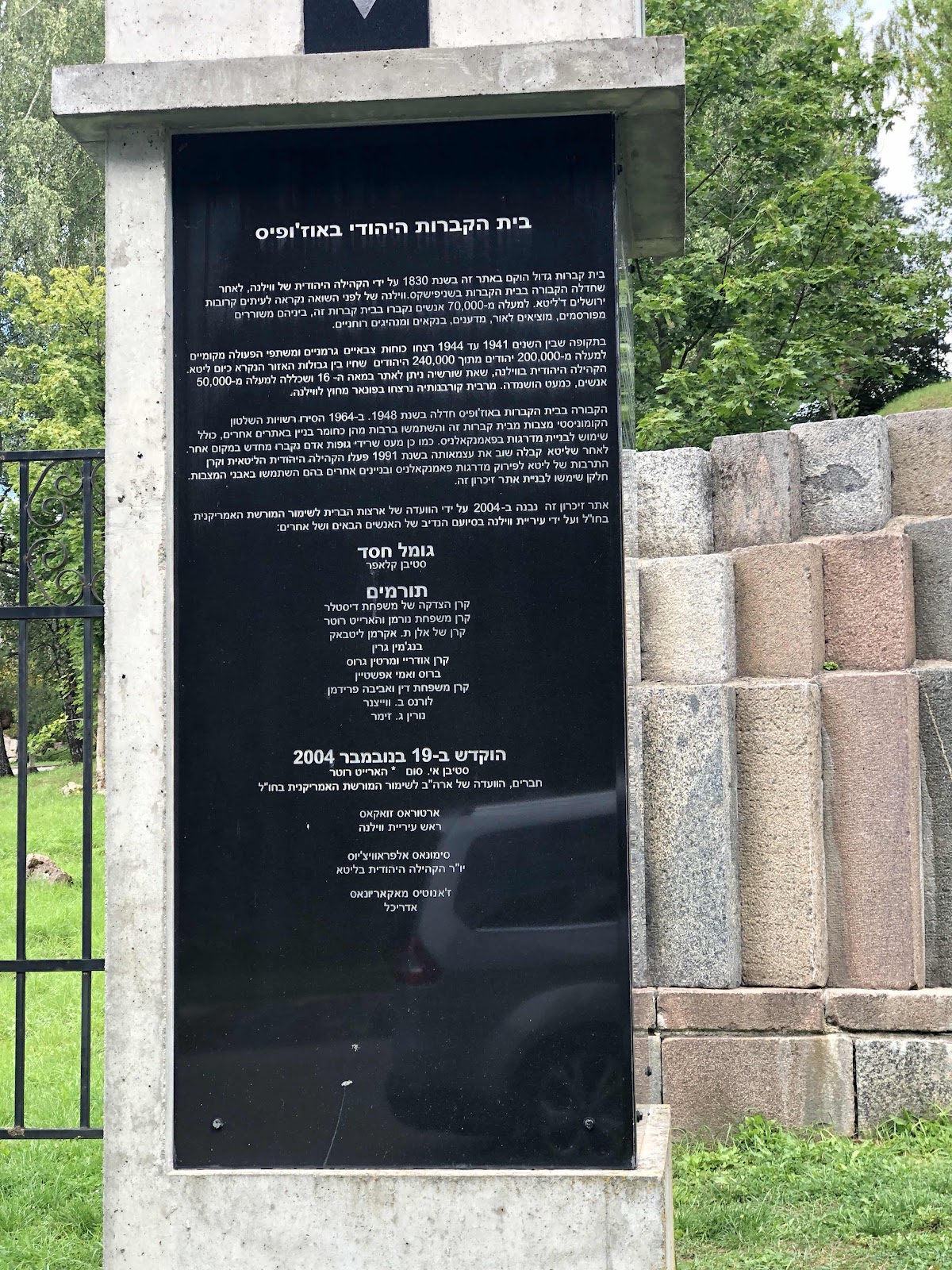
Today, Panery Forest is a section of the Vilna Gaon State Museum of Lithuania. When arriving at the site, there is a large monument that appears to have been cut in two. It seems that when the Soviets first erected the monument, it stated that here was the site where “more than 100,000 Soviet citizens” were shot to death. After Lithuania became independent, pressure was brought to bear to change the sign to read “100,000 people, including 70,000 Jews; men, women and children”.
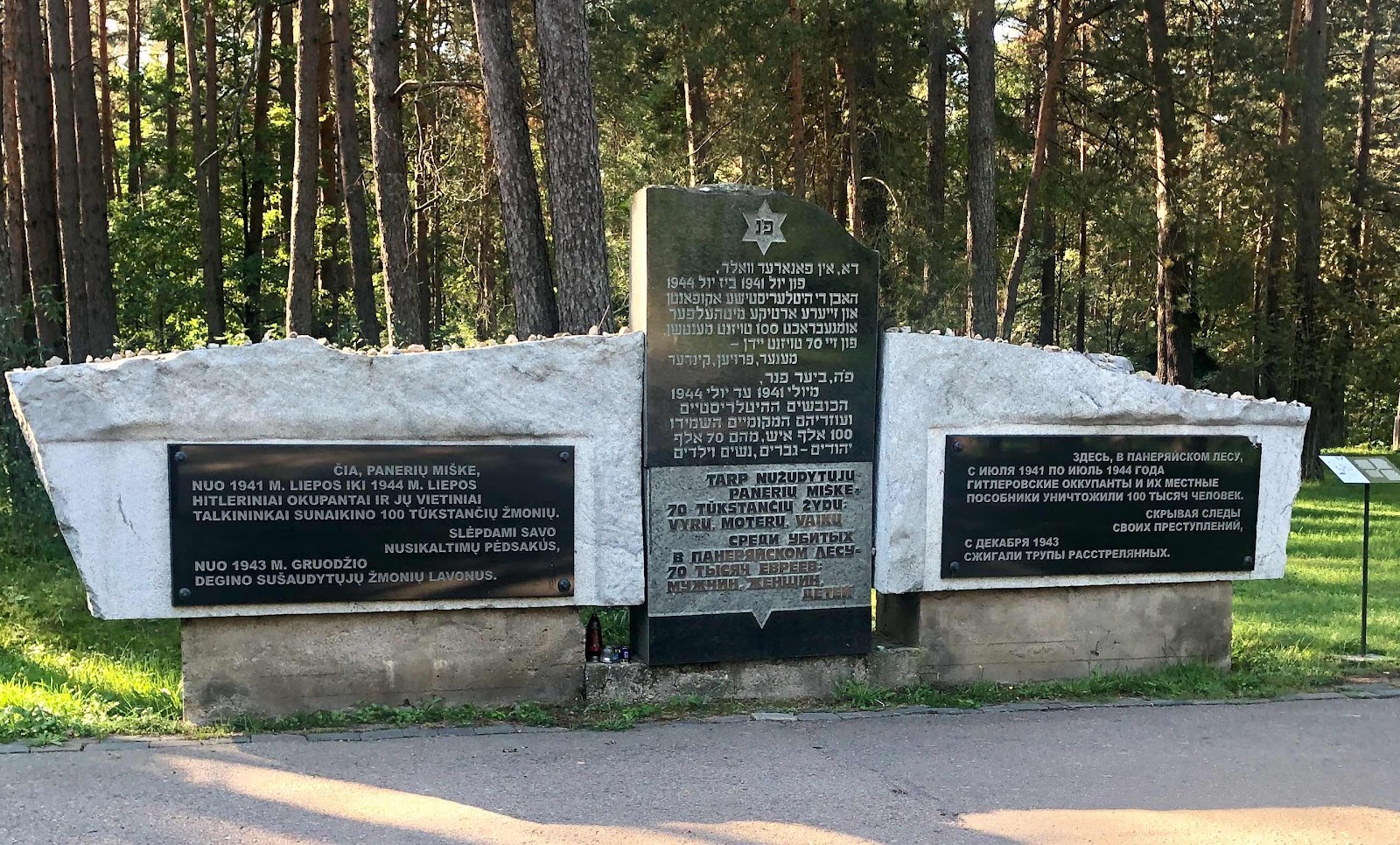
There are three separate memorials on the site, one for the Jewish martyrs, one for Poles and one for Russians.
In the Jewish area, there is small building which, in great detail, recounts exactly what happened in Ponar. It is horrifying.
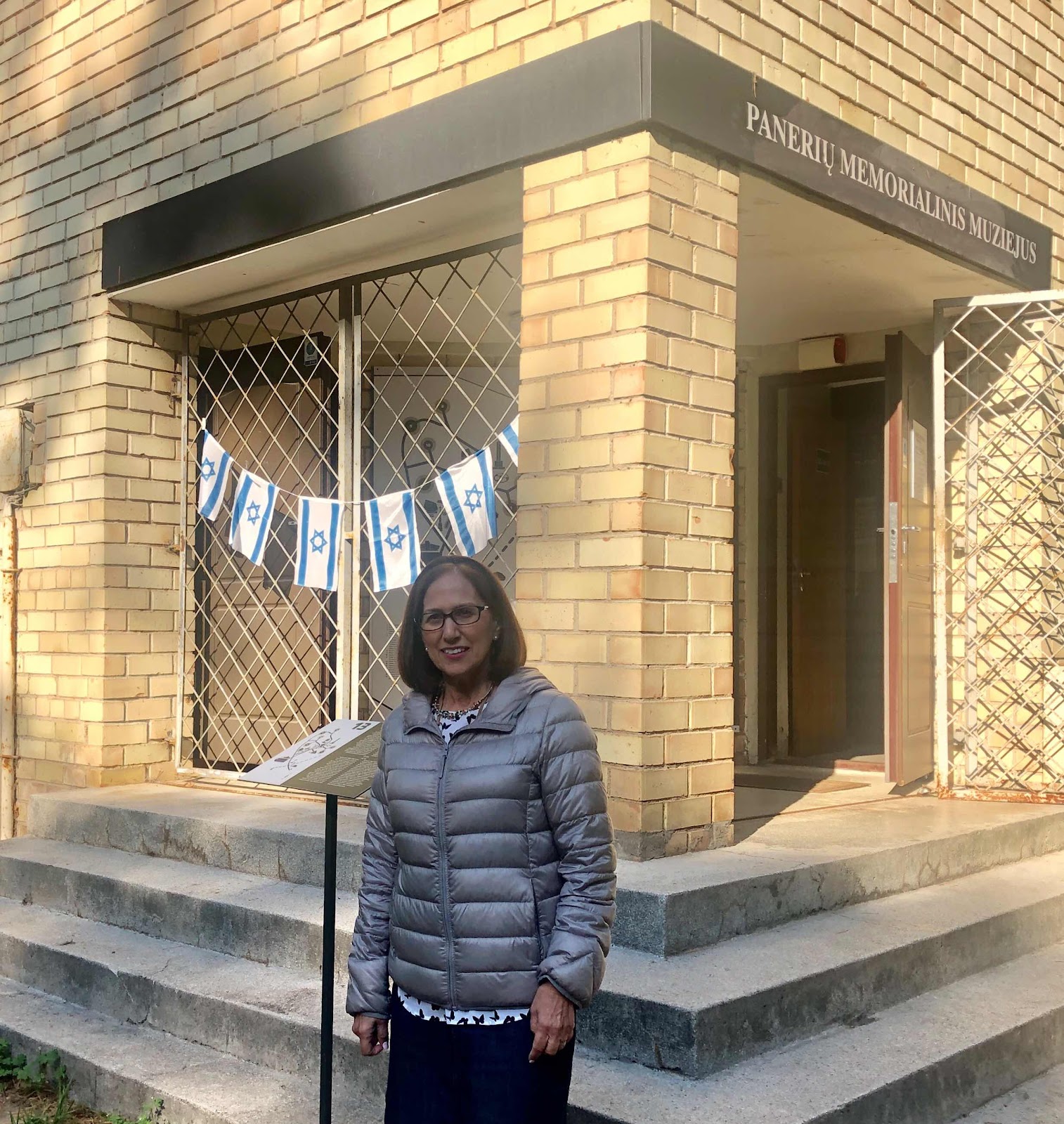
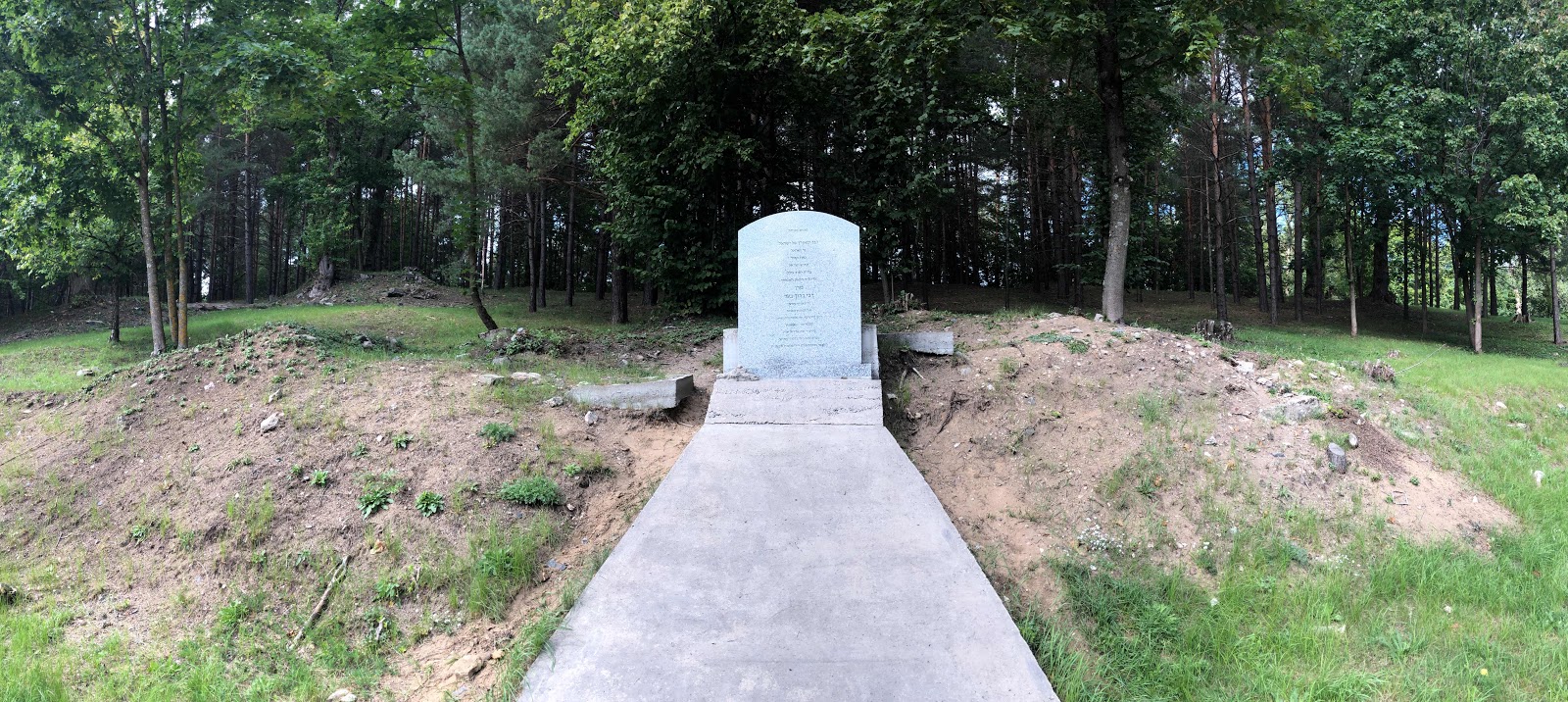
After reciting a memorial prayer at the Jewish monument, we walked to two of the large pits. Our guide pointed out to us that, having been here many times, he always notes that there are no birds in this forest. You see no life. You can feel the death. Even after being in Auschwitz and Majdanek, visiting places like this and knowing what happened here is too horrible to comprehend.
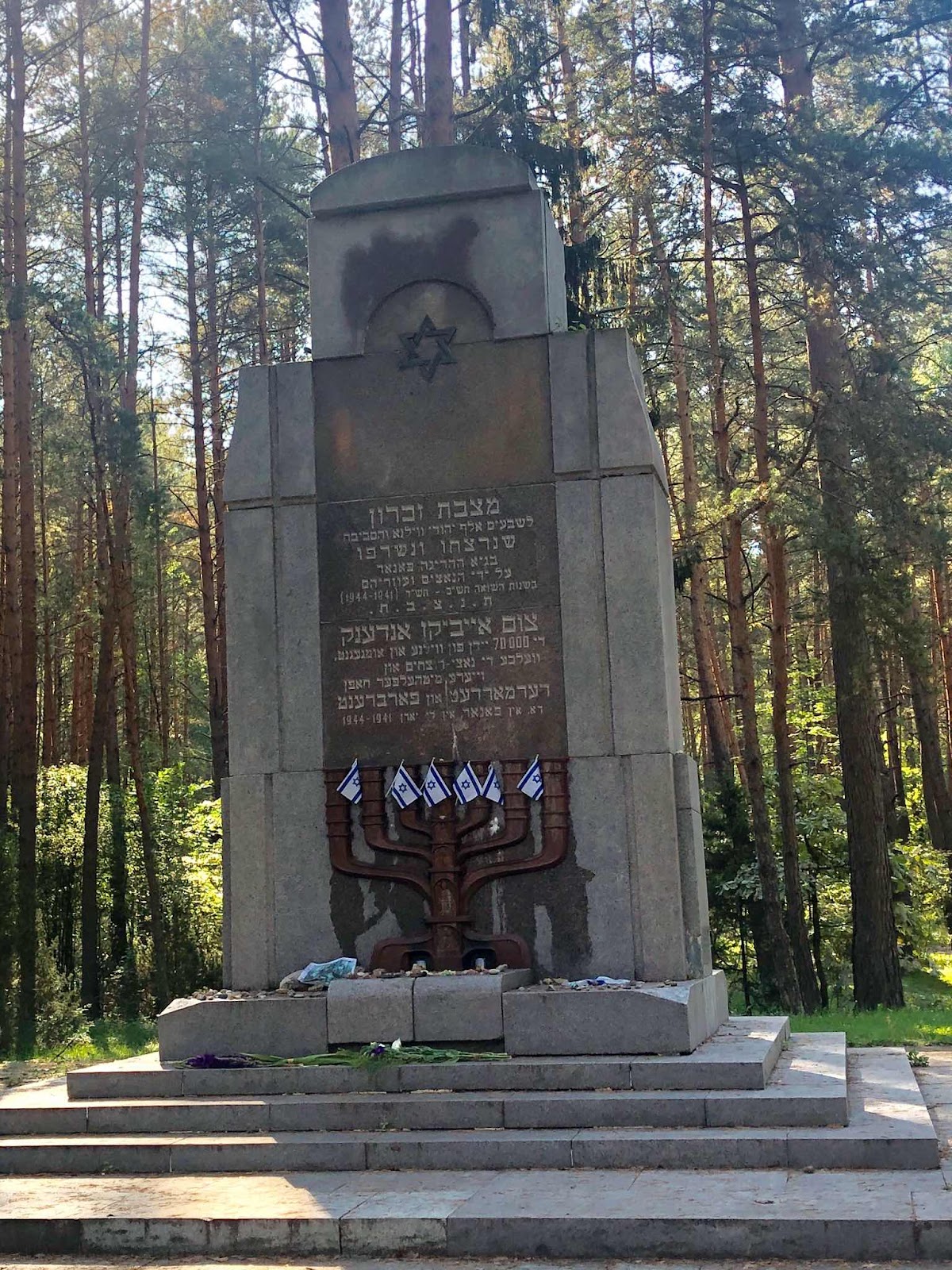
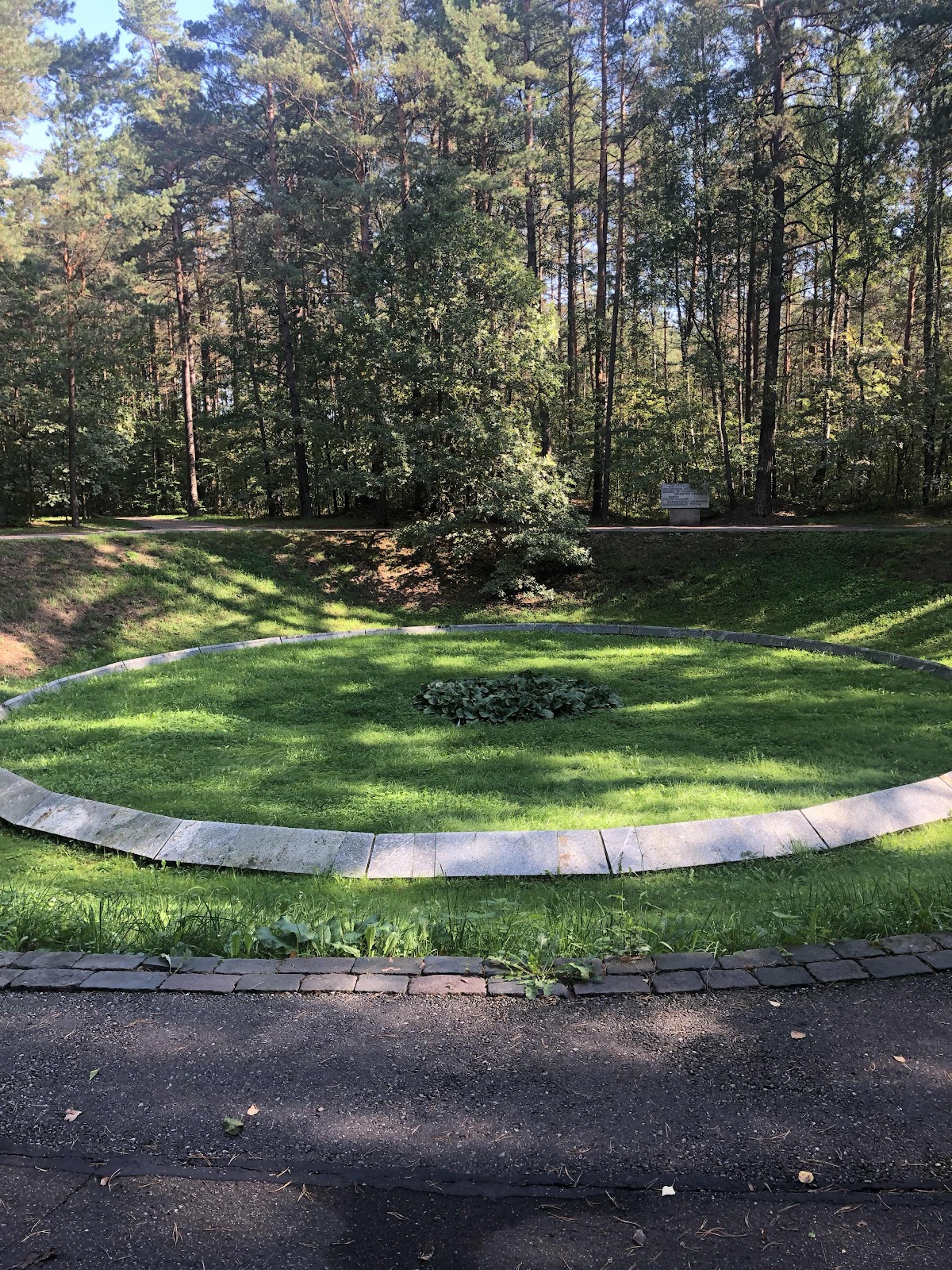
We walked back silently to the car and began our journey to our next stop, Alytus.
A bit of background: When we told our Rav, Rabbi Yirmiya Milevsky, that we would be visiting Lithuania and driving from Vilna to Kovno, he told us that his grandfather, Rav Aaron Milevsky, was once Rav in Alytus, located between Vilna and Kovno, and that the shul was still standing.
I did a bit of research and found out that the city of Alytus was renovating the synagogue and would restore it to its original grandeur. Rav Milevsky made contact with the city office and advised them that we would be visiting as representatives of the family. They responded immediately that they would be thrilled to greet us and tour the restoration of the synagogue together with us.
When we arrived in Alytus, we drove straight to the City Hall. The town has a bit more than 50000 residents and the city hall is a low rise modern building in the centre of town.

We were ushered into the office of the Vice Mayor, Jurgita Sukeviciene. She welcomed us and shared with us the details of the restoration and also advised us that it was fortuitous that we arrived this week, as this was Jewish Culture Week in Alytus. Amazed, I asked her how many Jews lived in Alytus and she answered “none”. But that Thursday night, there would be a Klezmer concert celebrating the culture and memory of Jews. We thought that it was quite ironic that a town with no Jews would have a culture week, but a few days later in the town of Shavel, we encountered exactly the same thing. It seems to be the thing to do in this strange country where Jews were almost totally annihilated and now they restore synagogues and celebrate a religion and culture that they intended to make extinct.
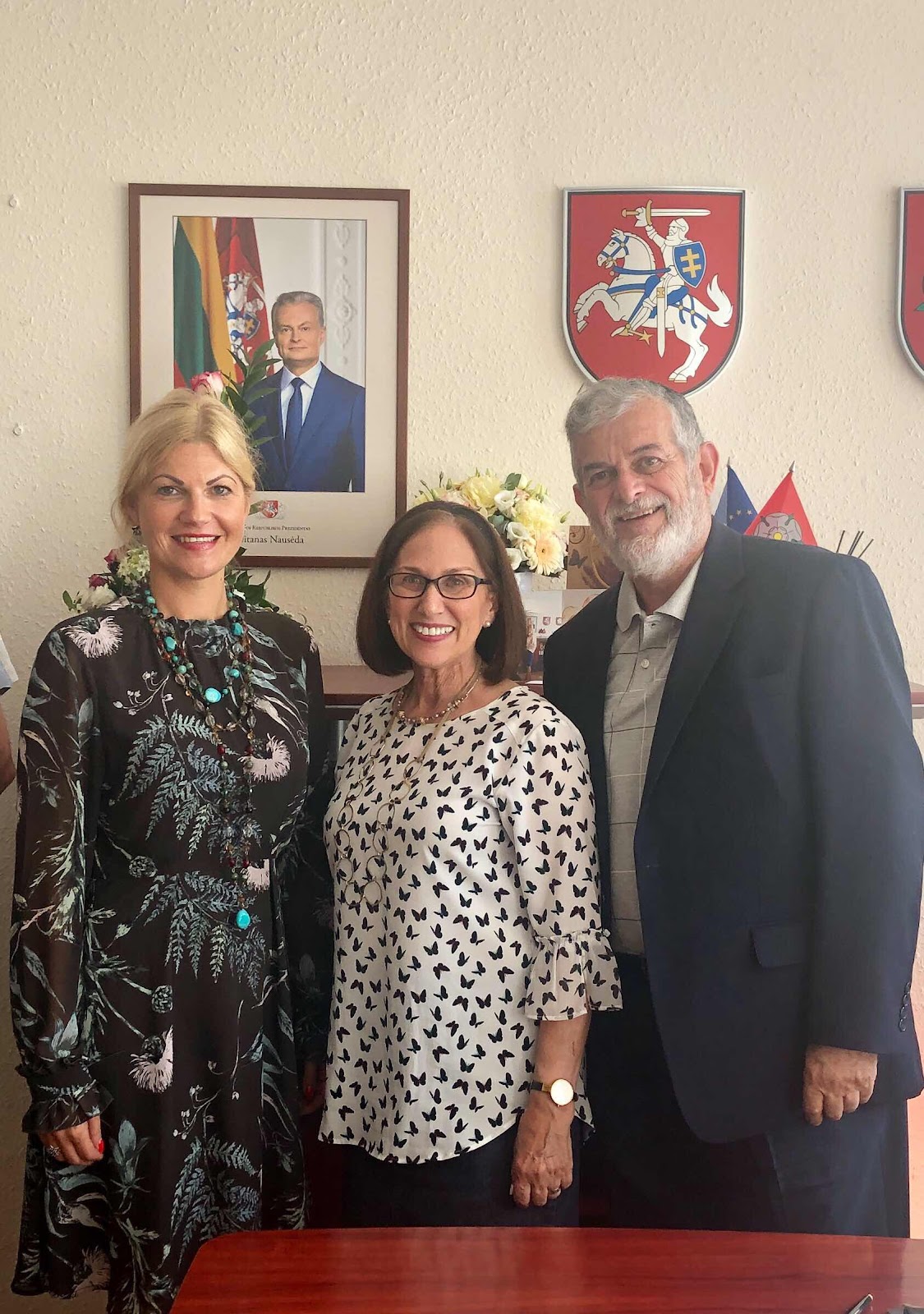
She asked that we stay for the concert, but we responded that we had already been invited to an amazing event at the Kovno Jewish Student Centre that evening.
After some photo opportunities and the presenting of gifts to us from the city, we drove to the restoration site. The sign says that the restoration includes the Synagogue and the Rabbi’s home behind it. We were accompanied by the director of heritage programs and the city PR person.
The shul was a large brick building and there was a hub of activity. This restoration has been ongoing for the past three years and will be completed in a little more than a year from now at the end of 2020. They are carefully removing the paint from the walls to uncover the original paint. They have installed an elevator and are installing heated flooring. The site of the bimah with four floor to ceiling poles remains as it looked back then. There is great attention being given to meticulously restoring the building, built in 1902, to its original grandeur.


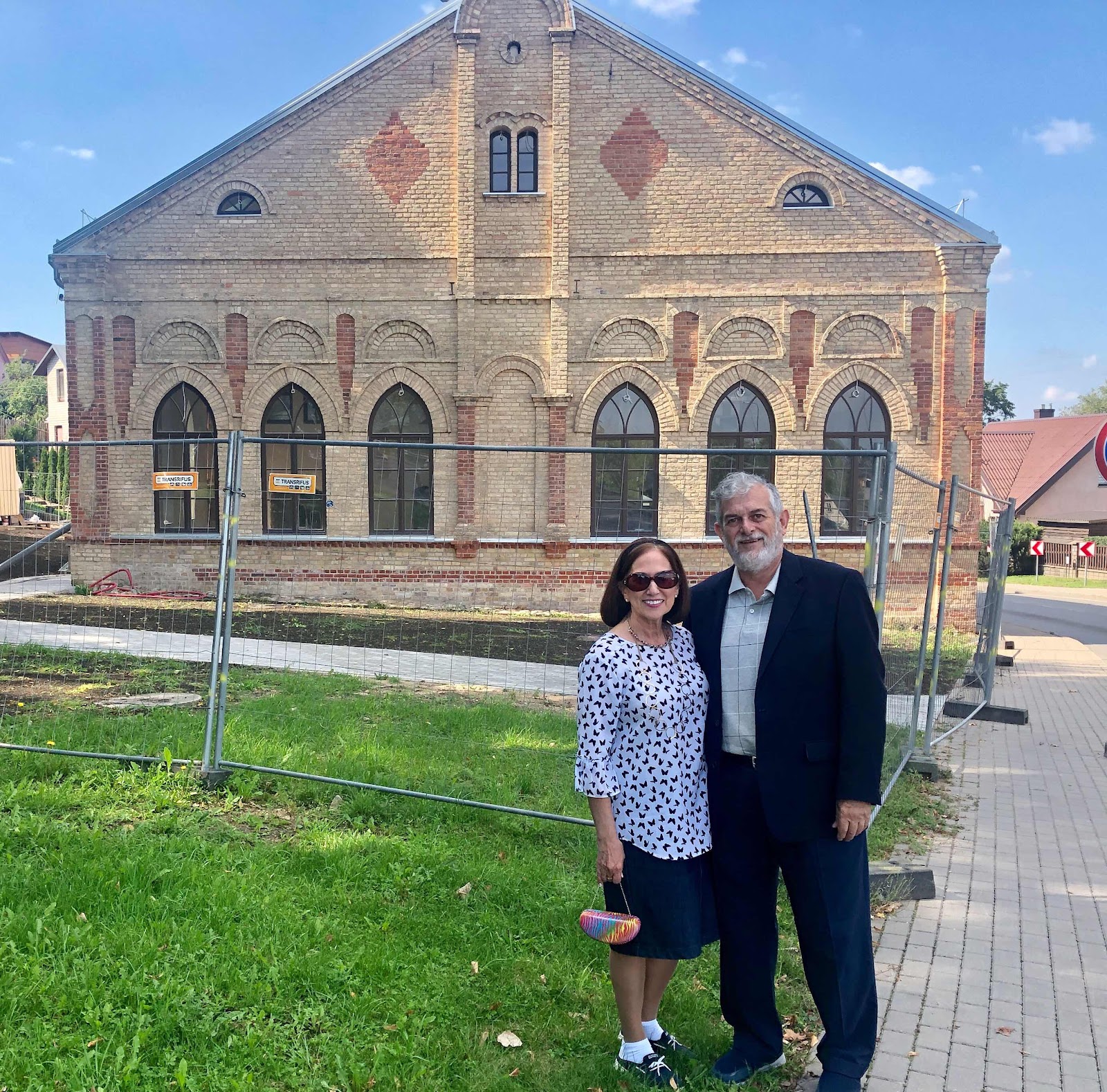
After the war, the Soviets used this building as a distribution centre for salt.
When they complete the renovation, they will use it as a cultural building for concerts, public gatherings, art displays etc.
From Alytus, we began to make our way to Kovno, so that we could arrive in time for the Hachnasat Sefer Torah at the Jewish Student Centre of Kaunas (Kovno). But first, some background.
When planning this trip or any trip, I try to schedule our movements based on a target location for Shabbat. And after looking at all of our choices for the two Shabbatot that we would be away, I settled on Stockholm and somewhere in Lithuania. I was not sure where minyanim could be found, but I was quite sure that Vilna had a minyan. As I was doing my investigation, I read an article in Ami Magazine about the new Student Centre in Kaunas or as we call it, Kovno. Since my mother’s family hails from that area of Lithuania, I decided to check it out.
The article said that because the medical degree granted in Lithuania is accepted in Israel, many Israeli students decide to take their schooling there. And because there are Israeli students there, an organization called Nefesh Yehudi, with the assistance of London philanthropist Willie Stern, decided to establish a Student Centre and arranged for a young rabbi and his wife and small children to move there to provide services to the students. They were Rabbi Moshe and Ruchi Sheinfeld.
They were both Israeli and he had a successful run operating a similar Centre in Migdal HaEmek in Israel.
That was 6 years ago, and I had no idea of the current status of the centre, or even if Rabbi Sheinfeld was still there. I emailed him and promptly received a very warm and welcoming response. Over the few months before the trip, we exchanged numerous emails and he was very forthcoming with whatever information we required.
He told us that the centre was fully operational and that there is a kosher kitchen that provides daily meals to the students and that we were more than welcome to join.
As we got closer to the trip, Rabbi Sheinfeld emailed us advising that perhaps we should arrive on Thursday evening, as there would be a Hachnasat Sefer Torah taking place that evening; the first such event in Kovno since the Shoah, and that it would be at the new centre to which they had recently moved.
What we did not know was that the number of Israeli students and other Jewish students from elsewhere in the world (yes, even some from Canada) had now mushroomed to over 400 and the original centre was bursting at the seams, necessitating an expanded base of operations. And what we also subsequently learned, was that originally Rabbi and Rebbetzin Sheinfeld had signed up for 10 months just to get the place going, and were now on their sixth or seventh year with no signs of moving back to Israel. The young couple and their kids are on call 24/7 and their constant smiles and positive energy are the reason that so many of the Jewish students attend programs, shiurim and tefillah at the centre.
In all medical schools around the world, there is a ceremony of induction for first year students called the “laboratory coat” ceremony. The Kovno Jewish Centre holds its own such ceremony to welcome new students and to let them know that the centre is their home for as long as they are in Kovno. Mr. Stern gives each student their lab coat and he and Rabbi Moshe and Ruchie Sheinfeld personally welcome each new student.

This was one of the few places to which we have travelled where the local Jewish services were provided by someone other than Chabad.
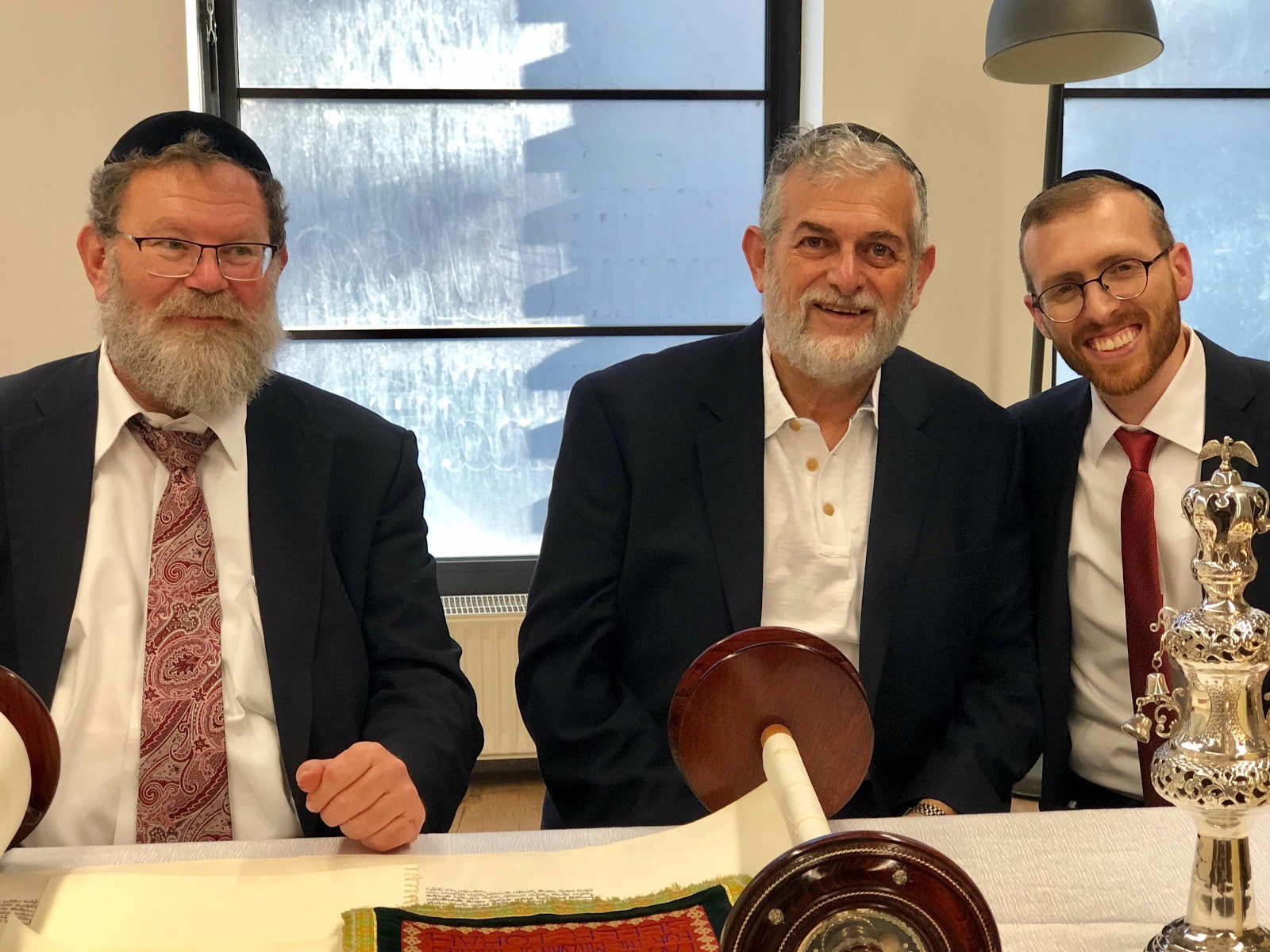
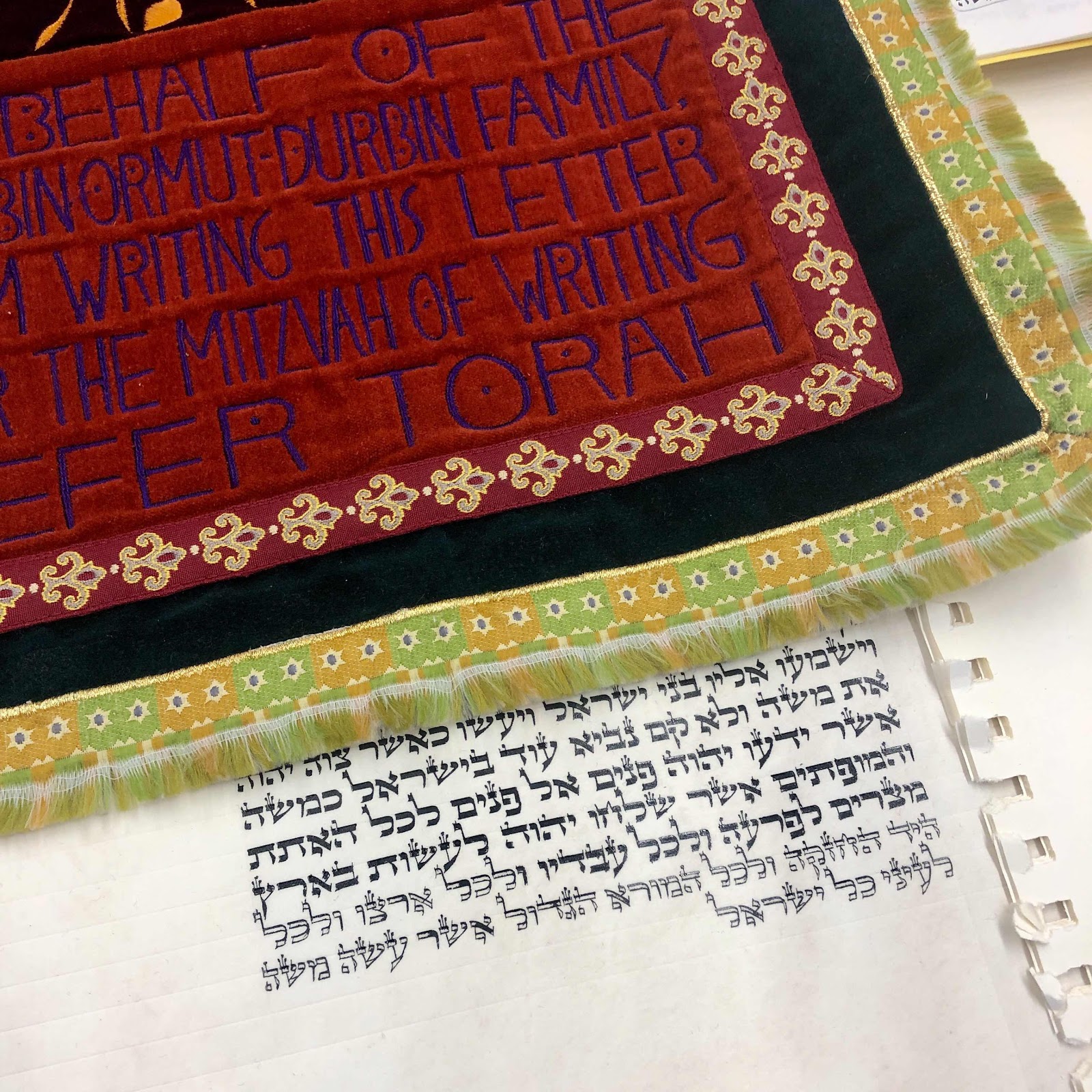
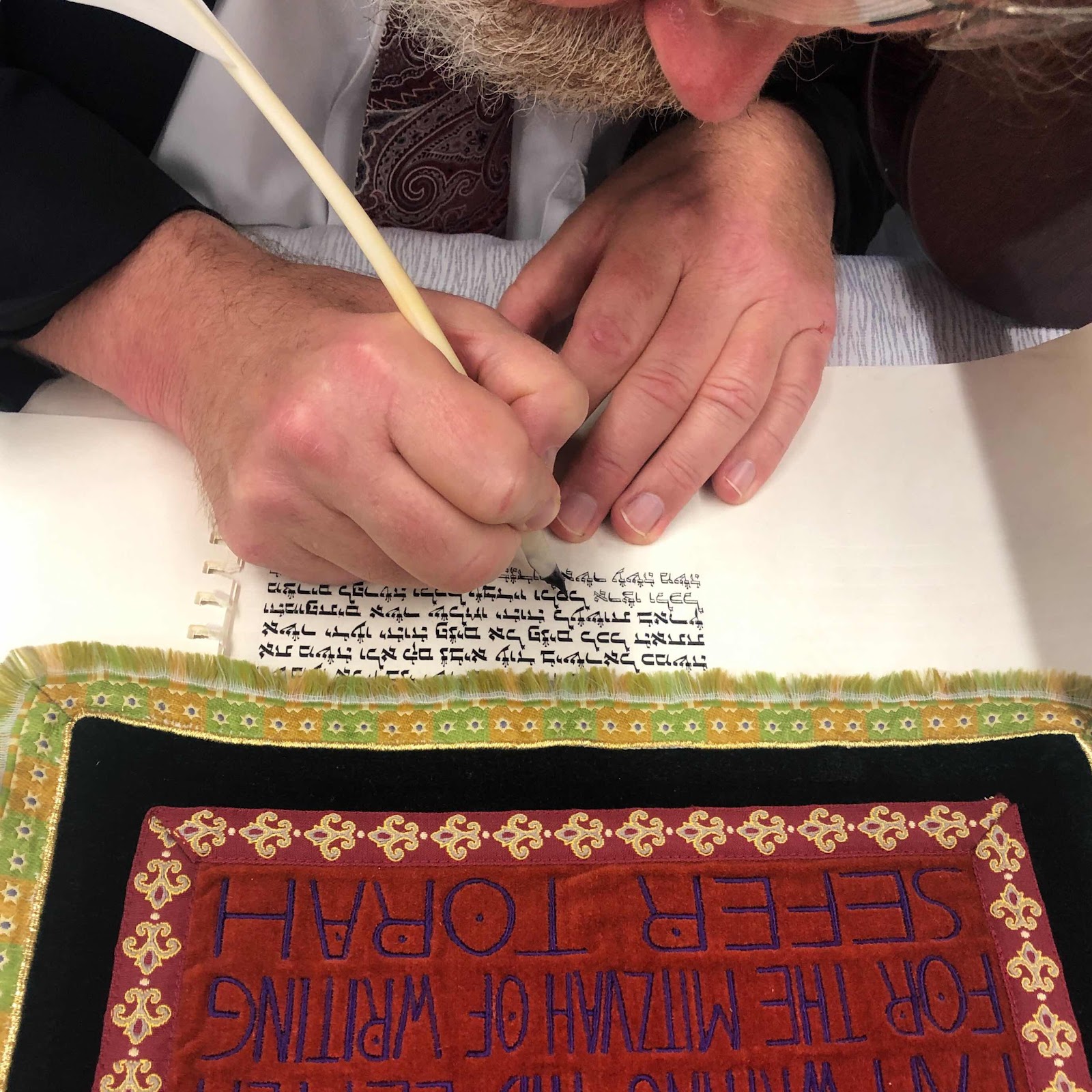
When we walked into the centre, off in a room to the side was a sofer from Israel, Rav Ezra Berger sitting and assisting people who were honoured with the writing of a letter in the new Torah. We saw the couple whom we had met a few days earlier at the Riga airport and also were introduced to the parents of the Rebbetzin who had flown in from Israel. As well, there were a number of couples who were attached to the centre, working there for a couple of years at a time.

Seated at the Hachnasat Sefer Torah with Rav Ezra Berger (l) and Rav Moshe Sheinfeld (r).
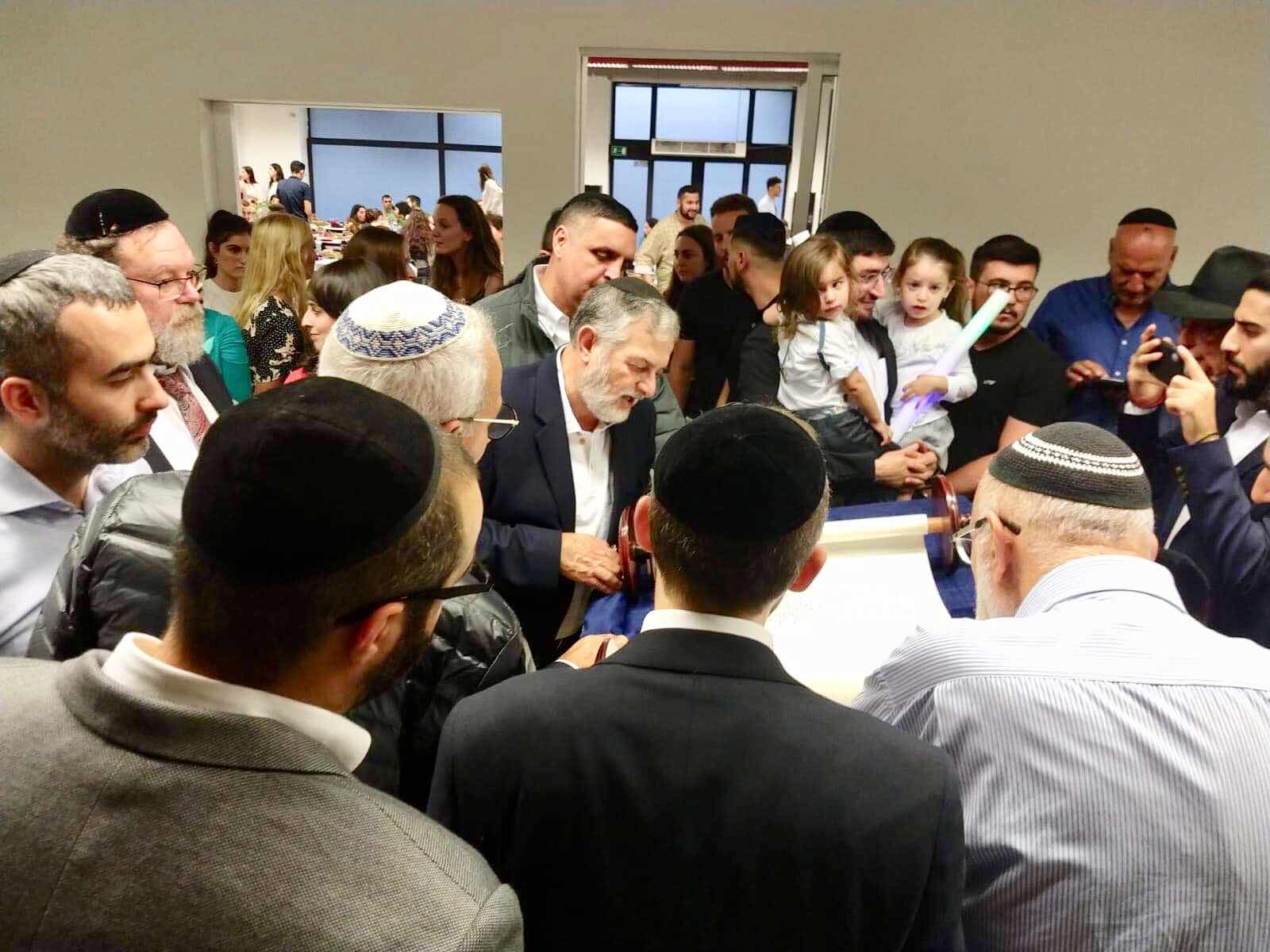
In the large room, long tables were set up to serve a few hundred people at the seudat mitzvah that would folllow the completion of the Torah. The two couples from Israel who had donated the Torah were honoured with the final letters in the Torah and then the joyous procession followed with many Israeli students joining in the singing and dancing.
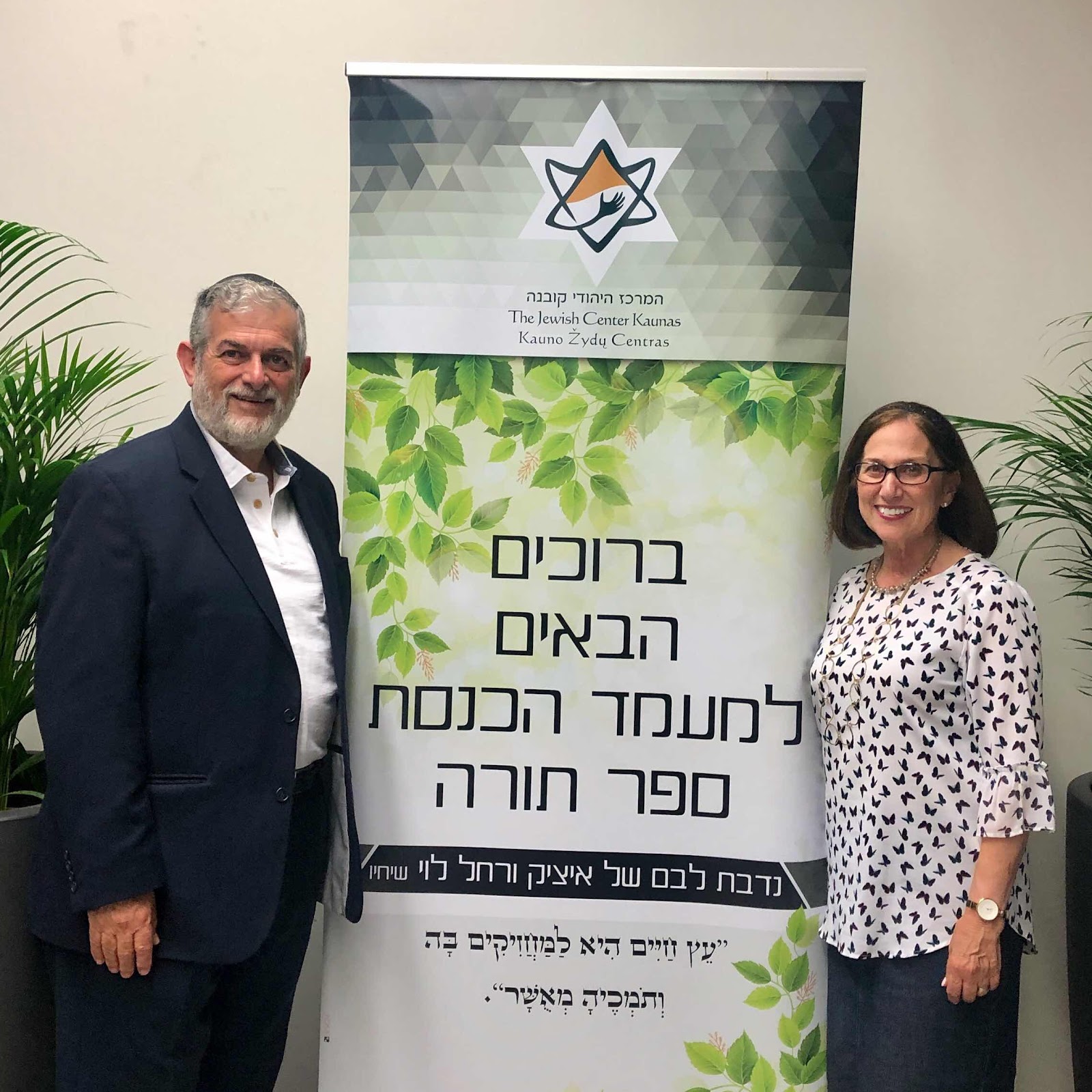

The staff of the Jewish Student Center in Kovno and their families.
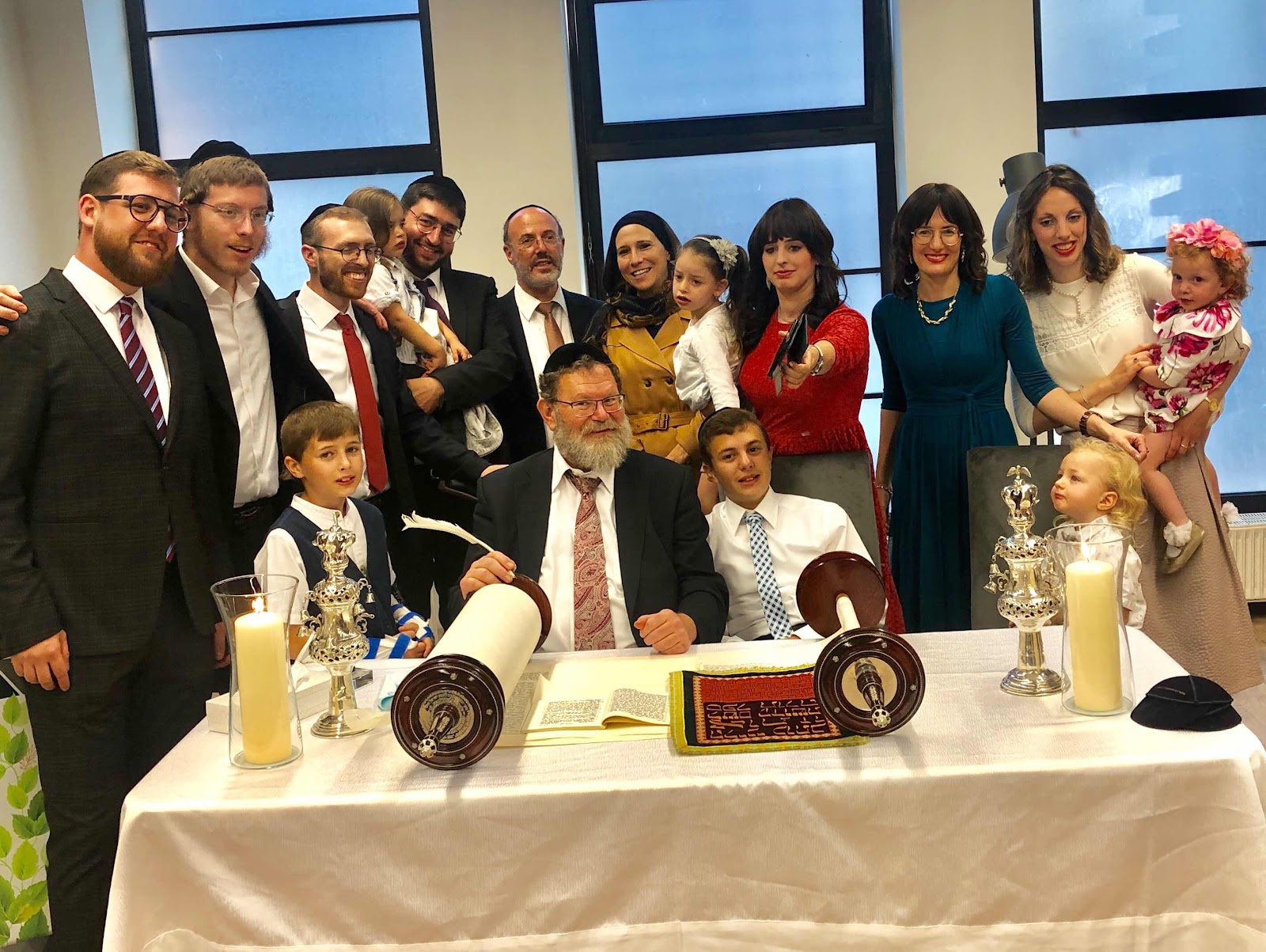
After beginning the day at the horrible Ponar Forest, the site of the mass killing of 70000 Jews, we really needed a joyous occasion like this one to emphasize that Hitler had not won the war. The architects of this centre, its leadership and the Israeli students, fresh out of serving in the IDF was proof positive that Am Yisrael Chai...we are alive and well and looking to the future.
Once they had ushered in the Torah to the small shul in the centre, they read the final portion of the Torah, the part where they had just written the final letters. And they asked if I would read the Torah for them. And because it was Thursday, they also asked that I read the weekly Torah Portion. What an honour! A few years ago in the Yeshiva of Chachmei Lublin in Poland, I was honoured with reading the Torah. These were both memorable places where I have been asked to read the Torah. Kovno and Lublin.
The meal that followed was wonderful and delicious. The mashgiach, a young chassid from Jerusalem gave us a tour of the kitchen and the chef, a local Lithuanian woman, told us how she was now familiar with all Jewish foods and the halachot and was now busy preparing the “simanim”, the traditional symbolic foods that we eat on Rosh Hashanah.
It was a great evening and we walked back to our Airbnb.
In the morning, we went to see the local synagogue, the only one remaining from the many Shuls that existed in prewar Kovno. The custodian of the shul, a local elderly Jewish man named Moshe, told us that during the war, the Nazis used the shul as a warehouse.
After the war, when survivors first began returning to the shul, there was a note on the front door in German that told them where to find the Shul’s keys, buried in the ground in the back of the shul. They entered and were amazed to find the Aron Kodesh, some of the sifrei Torah and many of the holy books intact.
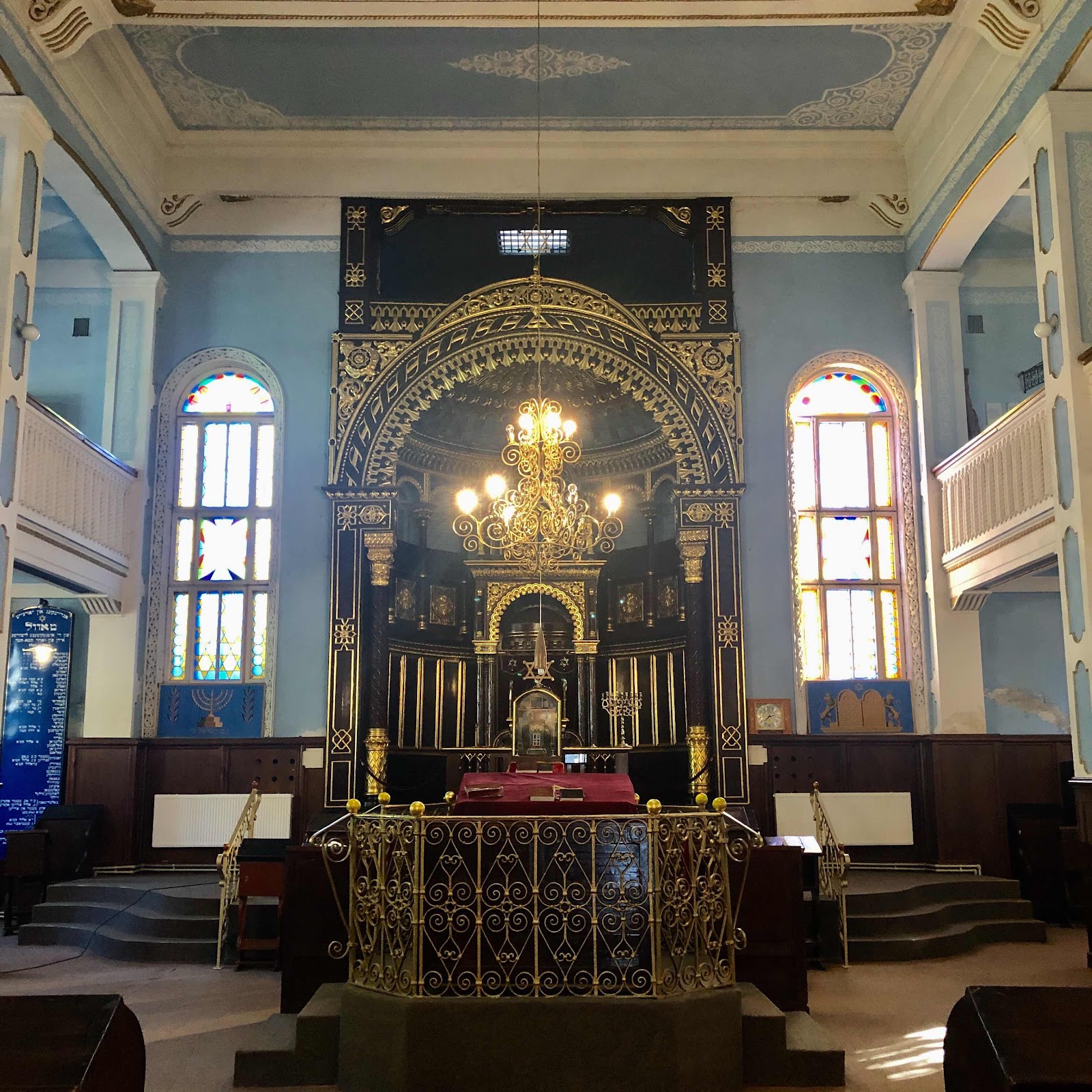

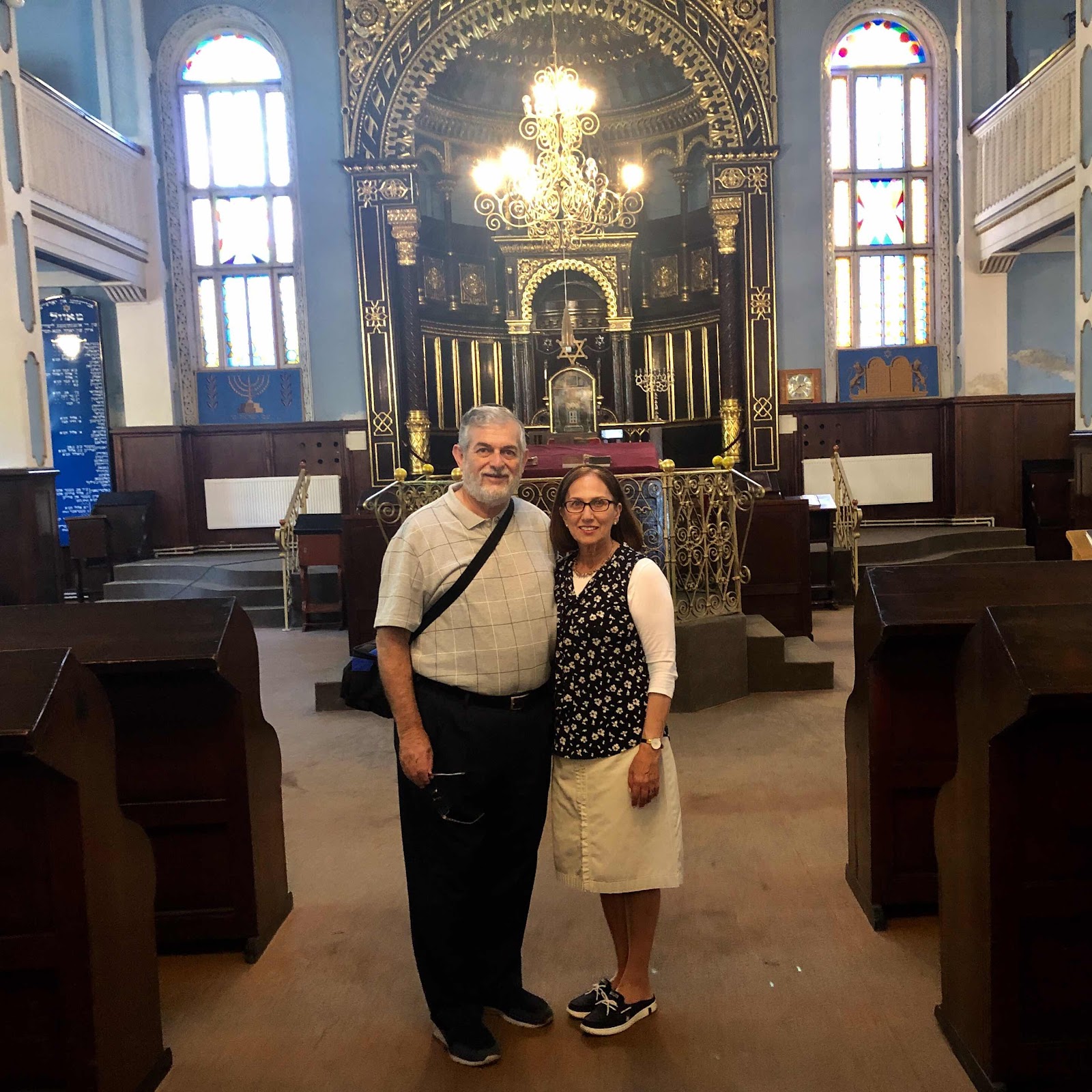
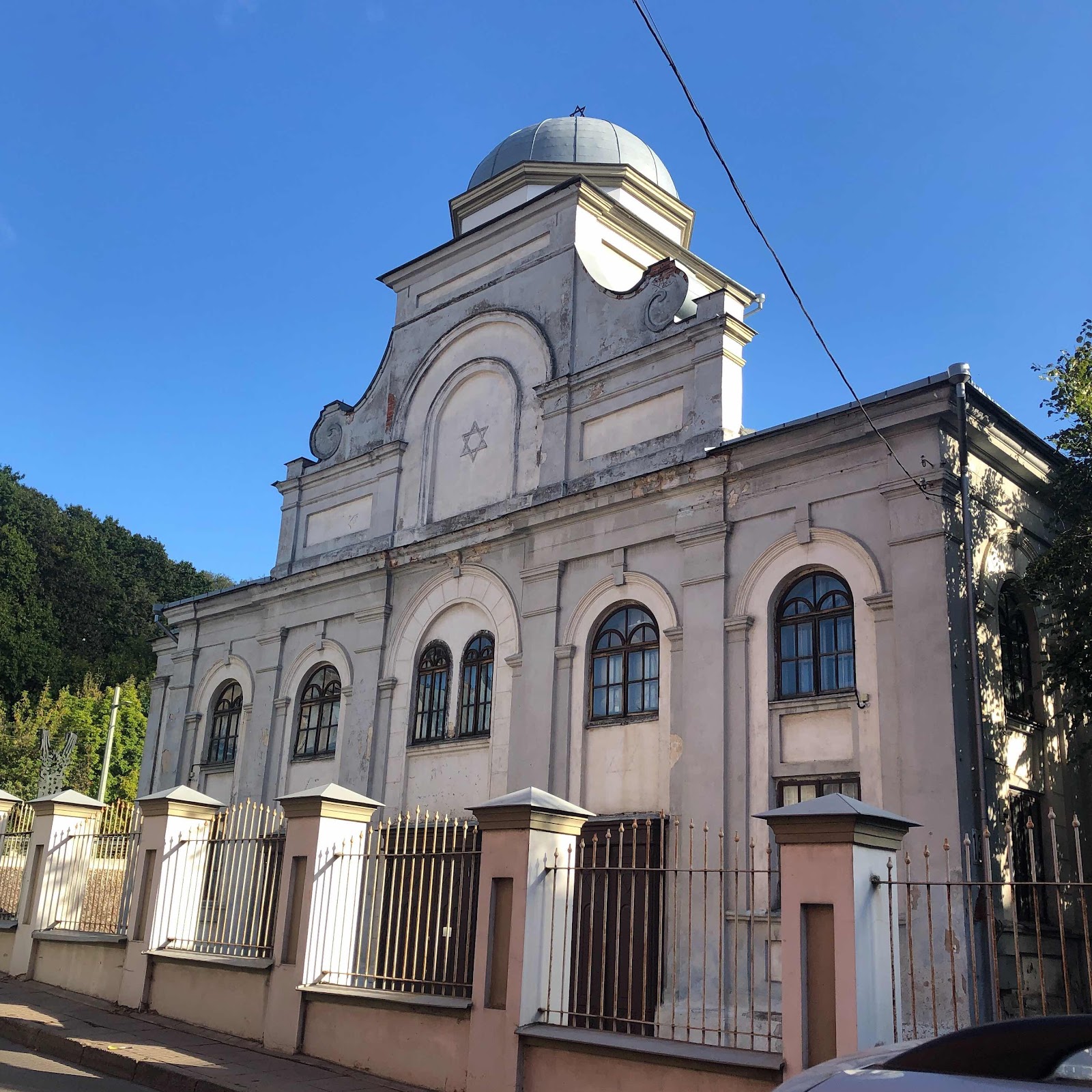
Moshe told us that they rarely have a minyan even on Shabbat. There are 40 Jews living in Kovno and the only place that seems to be flourishing is the Student Centre of Rabbi Moshe Sheinfeld. It was so sad to see what once was and to realize that at sometime in the near future, this beautiful shul will likely be empty. One of the readers of this blog, Florence, wrote to me last week, that empty synagogues and full cemeteries are all that remain of a once flourishing Jewish community... tragic!
From the shul we walked about 30 minutes thru Kovno to the house of the Japanese Consul Sugihara, who was responsible for saving the lives of about 6000 Jews, including the entire Mir Yeshiva, by writing entry visas to Japan.
Sugihara was based in Kovno and defied his government by writing the visas. He was eventually stripped of his position and lost his diplomatic status, but said that would do it again because it was the right thing to do.
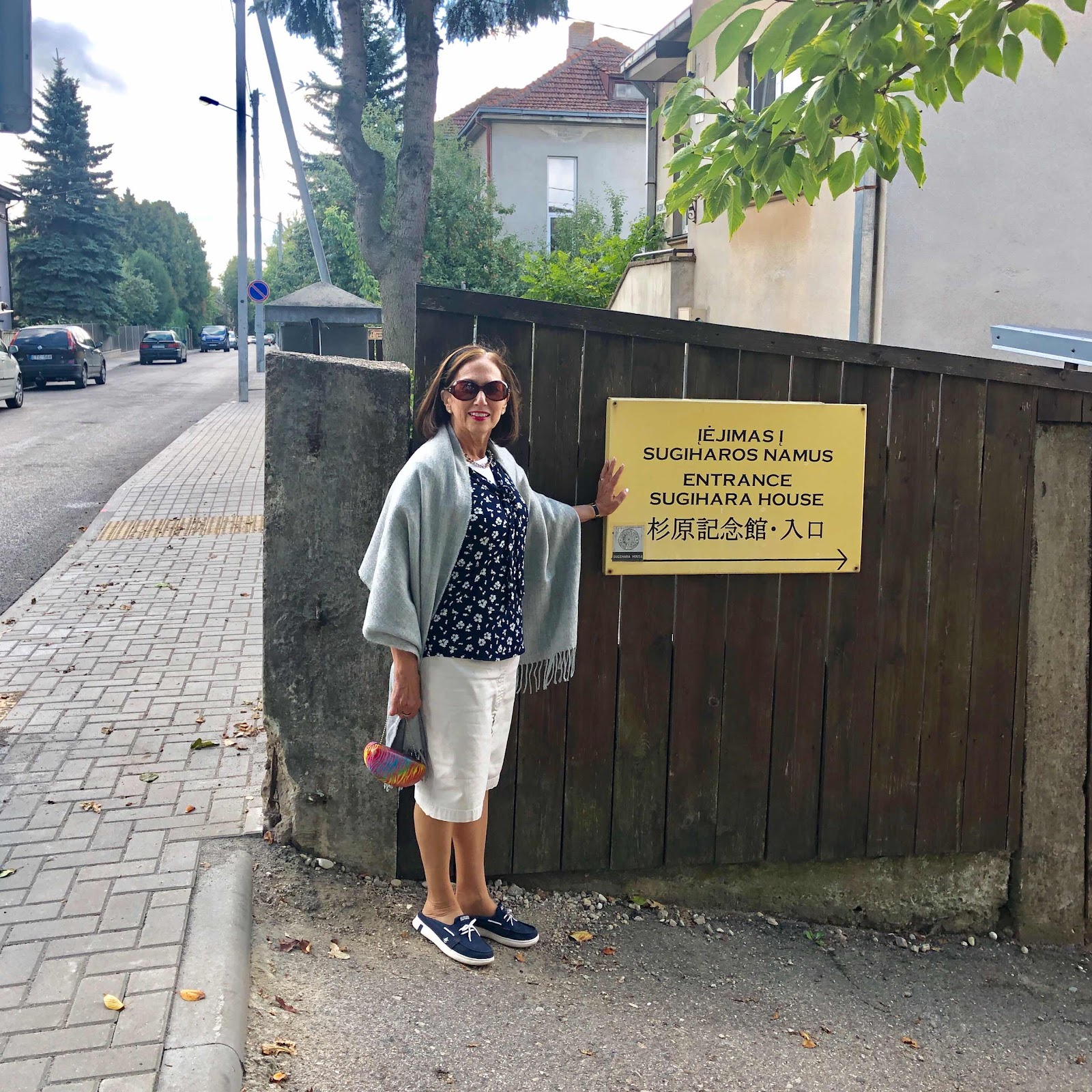
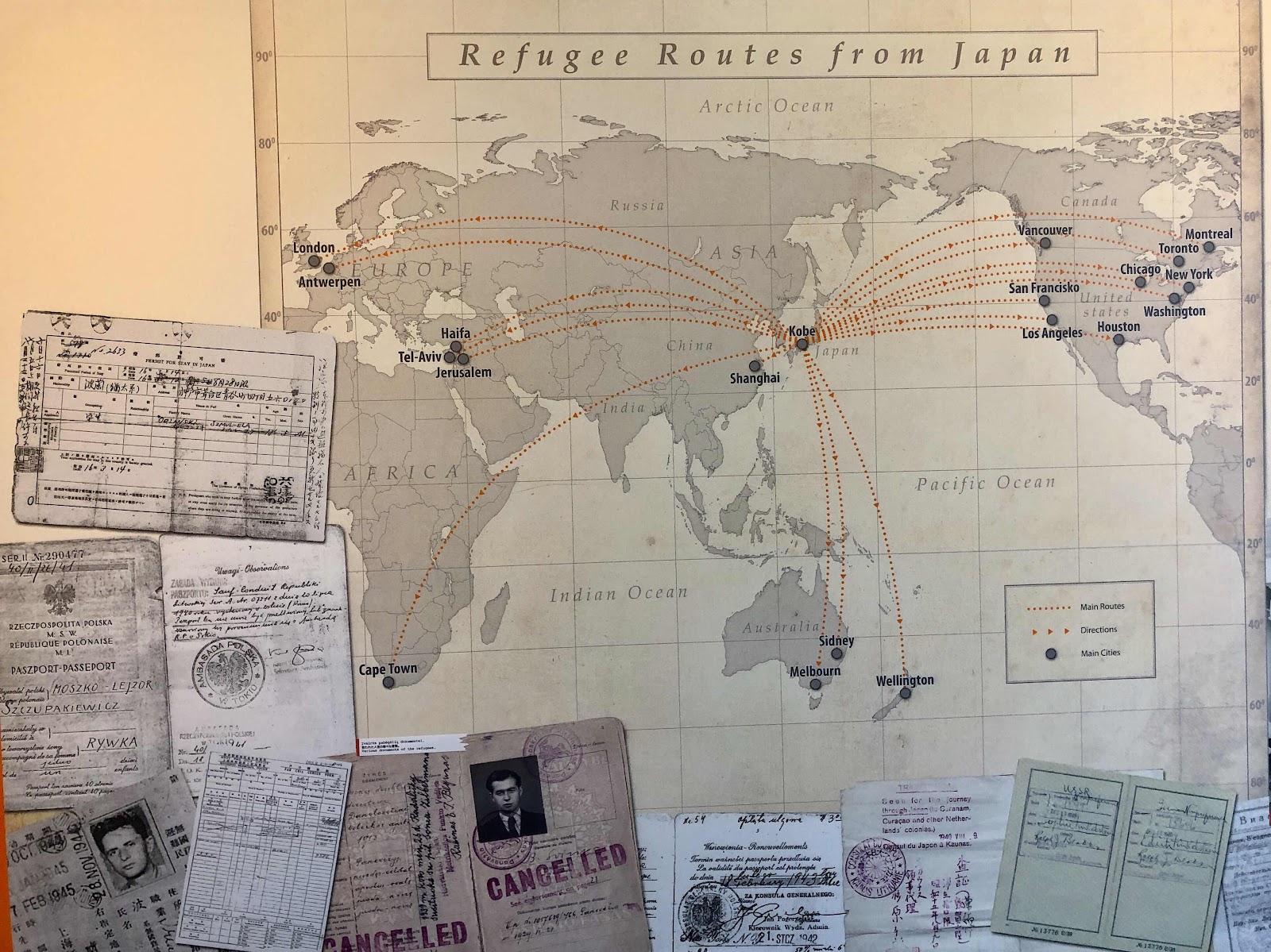
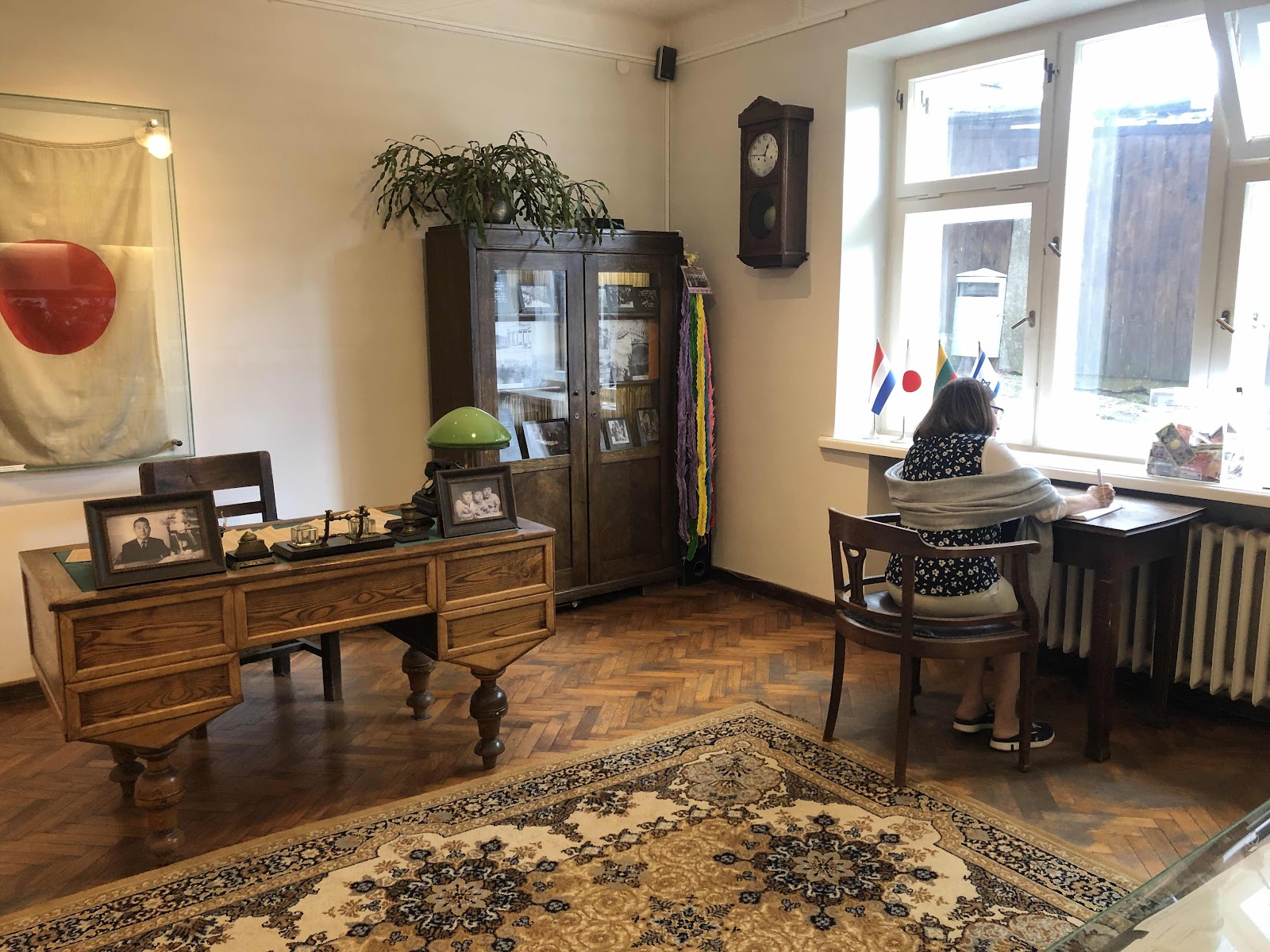
It is estimated that 60000 people are alive today as a result of the visas that he granted. We are fortunate to know a number of families that were the recipients of the Sugihara passport. In the house, you can visit the room where the passports were written, see a short film about the event and gain an understanding of how just one man can make a huge difference by remaining steadfast in his beliefs and ethics.
The last place that we visited in Kovno on this Friday was the Ninth Fort.
At the end of the 19th century, eight forts encircled the city of Kovno and provided protection for the city. In 1902 the massive ninth fort was begun and completed some 10 years later. It was used as the Kovno city prison from 1924 on. From 1940 to 1941, during the Soviet occupation of Lithuania, it was used to house political prisoners being transferred to the Gulag. Once the Nazis took over, the Ninth Fort was converted into a place of mass murder. Most Jews transported from the Kovno Ghetto were killed by the Nazis and their Lithuanian helpers. It is estimated that between 45000 to 50000 Jews were murdered in the Ninth Fort.
One of the most famous victims was the saintly Rabbi Elchonon Wasserman, zt”l.
In 1984, a monument was built to the memory of those killed here. It is three huge statues; one representing death, one representing resistance and the third representing emerging life and hope.

At the end of our tour, I asked our young Lithuanian guide “could this happen again?”. We were astounded at his response. He said, “I suppose it could not happen again to Jews in Lithuania because there are no more Jews to kill”. But then he continued, “but it could happen to Poles or Russians, two people that Lithuanians hate”. Very scary!
We returned to our apartment to prepare for Shabbat at the Student Centre, called for 8 PM.
Again, the place was packed with students. We had a minyan attended by all the guests and a small number of students, and then moved into the larger room for Seudat Shabbat. There must have been 200 students there. Lots of camaraderie, hugging, kissing, and quite noisy. Very few kippot among the males, certainly no dress code for the females.
Rabbi Sheinfeld told us over Shabbat that he has two basic rules; everyone has to be Jewish; no one can bring in a non Jewish spouse or partner. And on Shabbat, inside the centre, there can be no chillul Shabbat, no desecration of Shabbat.
He feels that his basic role is to provide a traditional positive outlet for Jews to meet, interact, celebrate and socialize. Before he came, students would come from Israel and there was no chance to socialize in a positive Jewish atmosphere.
When parents call him from Israel and ask him whether they should send their children to Kovno for medical school or to stay in Israel, he tells them to stay in Israel. But once they are here, he feels that he has a responsibility to provide a home experience for every student that he meets.
We watched him working the crowd, he knows all of them. Some are already in their sixth year and some have just arrived. Some of the students spoke in glowing terms about how they have grown in their religion since coming to Kovno and how the centre has provided an experience as close to home as there could be. They spoke about the dedication and commitment of the rabbi and his Rebbetzin. One young lady stated “who would have thought that I would have to travel from Israel to Kovno to grow in my religion?”.
The entire Shabbat experience was wonderful. Shabbat morning, kiddush, lunch, Mincha and Seudat Shlishit, all in a very Jewish and warm atmosphere. At the end of Shabbat, Rav Sheinfeld gave us one of the sefarim that he has written on the Parshah of the week, and the holidays of the year.
Next we will travel to see the burial place of my great grandfather and visit a number of communities that were once flourishing Jewish communities in Lithuania, Latvia and Estonia. And then back to Toronto.
All the best
Fran and David